Skip to the day
LiveWW2The Second World War, in real time
Day 1
Friday 1 September 1939

Germany invades Poland at dawn; Danzig proclaimed part of the Reich

From the LIVE WW2 feed

The day in dispatches

The first day of the war, as it was filed
Newest first
Situation mapEastern Front

Where the front lines stand tonight

By nightfall German forces have pushed into Polish territory at every point of entry: from Pomerania towards the Brda, from East Prussia towards Mlawa, and from Silesia and Slovakia into the southern districts. The line shown is approximate, and is compiled from both sides' reports. In the Free City of Danzig, the garrison at Westerplatte is still holding.

German positions reported at the close of the first day. Map: LIVE WW2.

Compiled from German High Command communiqués and Polish General Staff bulletins
Editorial

Britain sent Berlin a warning today. The guarantee promised more than a warning.

The Imperial Review

In March this country told Poland that if her independence was threatened, Britain would come to her aid. It was an easy promise at the time. Distant, conditional, about a crisis that hadn't happened.

It has happened. Tonight the promise has been restated rather than acted on.

What Britain and France did today was send Germany a warning. That isn't nothing. The note delivered to Berlin this evening says both governments will meet their obligations to Poland unless Germany gives satisfactory assurance that it is withdrawing, and it says it in language with very little room in it. But a warning is not the guarantee.

Summary

What we know at the end of the first day

Poland was invaded before dawn, from three directions at once. Danzig has been proclaimed part of the German Reich, and the Polish Post Office there remains under attack tonight, its outcome unknown. President Mościcki has proclaimed a state of war and called the nation to its defence.

In Berlin, Chancellor Hitler has told the Reichstag that Germany is responding to Polish aggression, a claim Poland disputes entirely and which cannot be independently confirmed. Italy has stated it will take no military initiative for the present.

Britain and France have each delivered a formal warning to Berlin tonight, stating that their obligations to Poland will come into force absent a satisfactory German response. Neither government has declared war. No reply has yet been received from Germany.

At home, Britain has evacuated children from its cities and enforced its first blackout tonight. France has ordered general mobilisation. President Roosevelt has appealed to all sides to spare civilian populations from bombing.

Wire

France delivers a parallel warning to Berlin

Allied Press Service

France has delivered its own note to the German government tonight, following Britain's by a matter of hours and framed, French officials say, in similar terms.

The note is understood to warn that France's obligations to Poland, under the Franco-Polish alliance, will come into force absent a satisfactory German response. No fixed time limit has been announced from Paris tonight. French mobilisation, ordered earlier today, continues.

Communiqué

Text: Britain's warning to Berlin

Allied Press Service

The British Government's note to Berlin, delivered this evening through His Majesty's Ambassador, is published below in the form released by the Foreign Office.

Official textHM Government (British Foreign Office)

Sir, In the communication made to you today, His Majesty's Government in the United Kingdom informed the German Government that, unless the German Government were prepared to give satisfactory assurances that the German Government had suspended all aggressive action against Poland and were prepared promptly to withdraw their forces from Polish territory, His Majesty's Government in the United Kingdom would, without hesitation, fulfil their obligations to Poland.

Wire

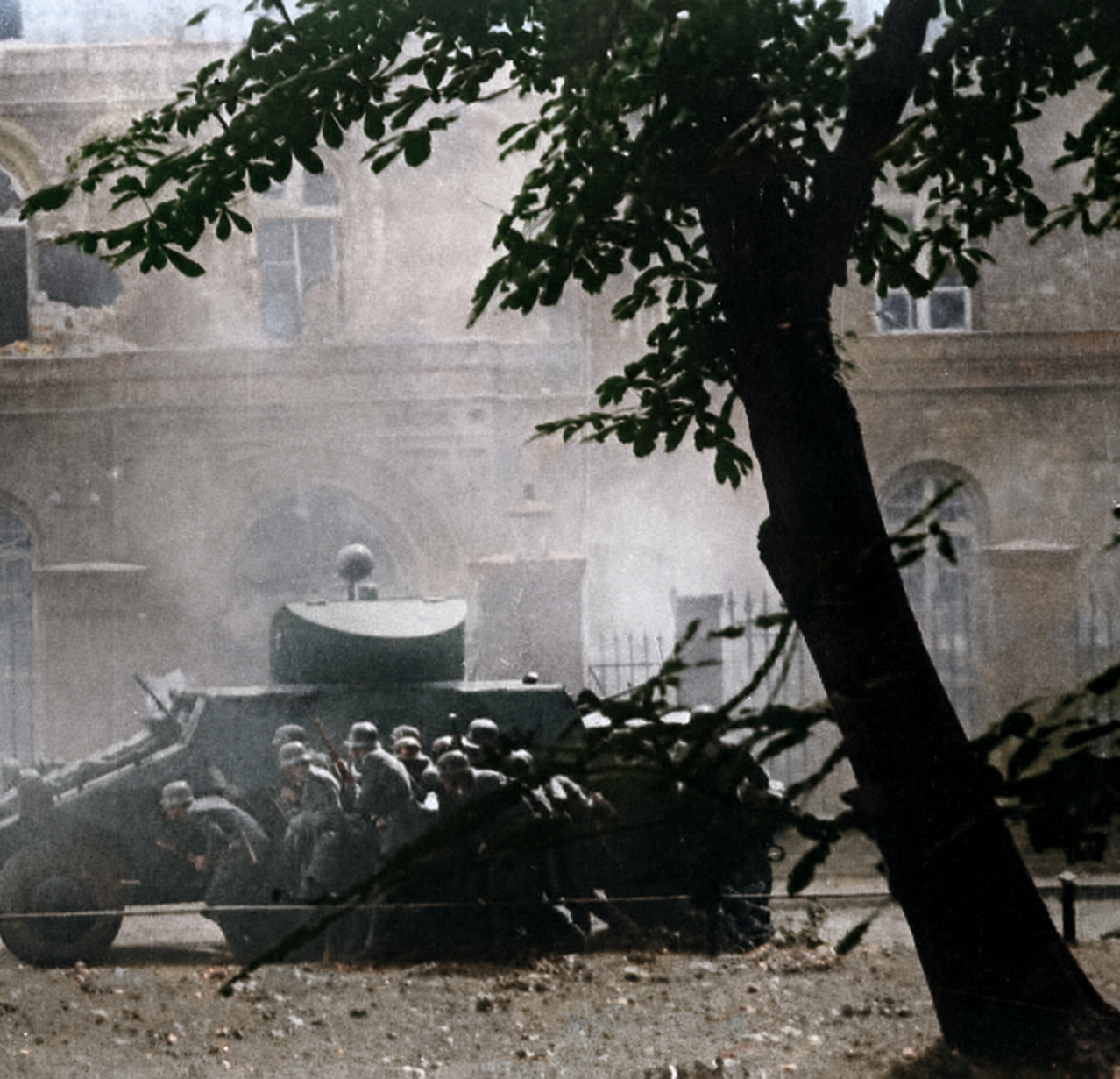
Polish Post Office in Danzig under assault

Allied Press Service
Troops in position around a large municipal building during an assault, smoke visible at street level.
The attack on the Polish Post Office, Danzig. Colourised from original Polish archive photograph. Photographer unknown. Source: Apoloniusz Zawilski, Bitwy Polskiego Wrzesnia. Public domain.

German forces have attacked the Polish Post Office in the city, a defended Polish institution that has become one of several flashpoints inside Danzig since fighting began this morning.

The outcome by this evening is not established, and no confirmed account of casualties or prisoners is yet available. Polish postal employees and other defenders inside the building are reported to have resisted through the day.

Eyewitness

First night of the blackout, and London can't see the kerb

The London Sentinel

At 19:45 a shopkeeper in Islington is still up a stepladder fitting black paper to his window, with three or four people waiting below for him to finish. They wait good-humouredly. There is nowhere else to buy anything.

The blackout order takes effect tonight. Every window in the country has to show no light at all.

Two doors down a woman hangs a blanket over her front room window, goes outside, looks at it, and goes back in to adjust it. By 21:00 there are no lit windows on the street.

A car comes past with its headlamps masked down to two slits, going slower than a car normally goes on a straight road.

Wire

Commons turns to emergency business

Allied Press Service

Alongside the diplomatic statement, the House of Commons has turned this evening to emergency business covering public order, supplies and the machinery needed should the country move to a full war footing.

Measures under discussion include emergency powers over transport, food and industry. The sitting continues into the evening.

Wire

Commons meets; Chamberlain confirms warning sent to Berlin

Allied Press Service

The House of Commons met this evening in emergency session, and the Prime Minister confirmed that Britain has sent Germany a formal warning over the invasion of Poland.

Mr Chamberlain told members that German troops crossed the Polish frontier this morning at dawn and that open Polish towns are being bombed. The note delivered to Berlin states that unless Germany gives satisfactory assurance that it has suspended all aggressive action and is prepared to withdraw its forces from Polish territory, His Majesty's Government will, without hesitation, fulfil its obligations to Poland. No German reply has yet been received.

Correspondent

Roosevelt appeals against the bombing of civilians

The New York Register

President Roosevelt has appealed directly to the belligerent powers not to bomb civilian populations.

The message, sent this afternoon to the governments of Britain, France, Germany, Poland and Italy, asks each to state publicly that its armed forces will not, under any circumstances, bomb civilian populations or unfortified cities from the air.

The appeal is framed here as strictly humanitarian, consistent with the neutrality the United States maintains by law. It asks both sides for the same undertaking and assigns responsibility to neither.

Whether it succeeds is another matter. Reports reaching Washington already describe bombing over a number of Polish towns since dawn. An appeal asking belligerents to state a policy they may already be violating carries an obvious difficulty.

Eyewitness

Every platform at the Gare de l'Est belongs to the army now

The Paris Dispatch

The departures board still lists civilian trains. The platforms are army.

Men in ordinary coats carry kit bags that don't match their clothes, issued this week from depots that hadn't expected to open yet. The queue at the barrier moves in short bursts under a gendarme who has plainly done this before and remembers the technique.

The mobilisation posters went up today and still smell of paste. Reservists stand in front of them checking their class against the day they're told to report. A man in his forties read his twice, then asked the man beside him to read it as well.

Correspondent

France orders general mobilisation

The Paris Dispatch

The Republic has ordered general mobilisation.

The decree, signed this afternoon following an emergency meeting of the Cabinet, calls the reserves of the French Army, Navy and Air Force to their depots, effective from the coming days. It is accompanied by a formal note, delivered jointly with Britain's, demanding that Germany withdraw from Polish territory.

France mobilised against the same enemy in 1914. The Chamber of Deputies has not yet been asked to vote on a formal declaration.

The practical machinery of mobilisation is already visible in Paris this afternoon: notices posted at town halls, reservists making their way to railway stations, private vehicles requisitioned for military transport under standing regulations.

Correspondent

Rome: no military initiative for now

The Stockholm Observer

Rome will not fight, for now.

The Italian Council of Ministers, meeting under Signor Mussolini this morning, has announced that Italy will take no military initiative in the conflict that opened in Poland at dawn. The announcement follows, rather than precedes, a telegram from Berlin: Rome asked to be released from the military obligations of the Pact of Steel, and Berlin agreed within hours.

Count Ciano, the Italian Foreign Minister, has separately floated the idea of a conference among the European powers to examine the disputes arising from the Versailles settlement, Danzig and the Corridor among them.

Rome presents this as statesmanship. Officials elsewhere read it as an admission that Italy's fleet, army and industry are not ready for a war against Britain and France, whatever the Pact of Steel says on paper.

Summary

What we know at midday

By midday, the shape of the day is this. German forces crossed the Polish frontier before dawn from three directions, with fighting continuing along all fronts and communication from the Polish interior intermittent. Danzig has been proclaimed part of the German Reich, and Polish positions at Westerplatte remain under attack.

President Mościcki has proclaimed a state of war, calling the nation to its defence. In Berlin, Chancellor Hitler has addressed the Reichstag, framing the German action as a response to Polish provocation.

Germany's justification rests on claims that cannot be independently confirmed from London or Stockholm, including an overnight report of a Polish attack on a German radio station at Gleiwitz. Poland disputes the German account entirely.

In London, evacuation of children from the cities began this morning under a long-prepared scheme. Only Germany and Poland are so far engaged in military action.

Correspondent

Poland was attacked from three directions at once, on a pattern that takes months to prepare

The Imperial Review

Poland was attacked from three directions at once this morning, not across a single frontier.

German forces came from East Prussia in the north, from Pomerania and Silesia in the west, and from Slovak territory in the south, with Danzig and the Baltic coast making a fourth front on its own. Border incidents don't look like this. This took months to arrange.

The geography matters more than any one day's fighting. A three-sided attack forces the Polish command into an immediate choice: concentrate near the frontier for a decisive battle, or pull back to defensible lines further east and give up the industrial west while doing it. Both options are bad. They have to pick one today.

Correspondent

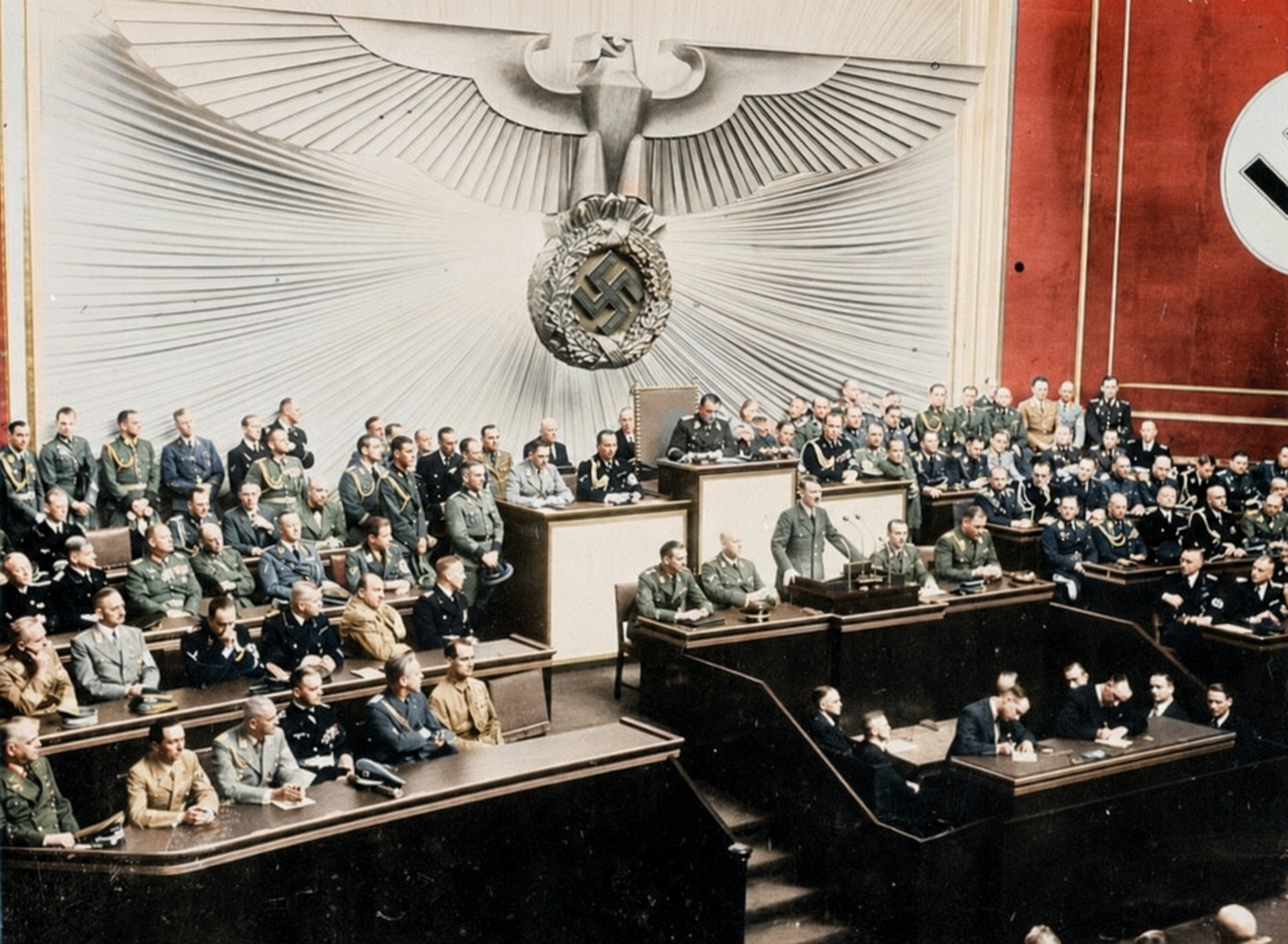
Hitler to Reichstag: "We are now returning fire"

The Stockholm Observer
A wide view of a speaker at a lectern addressing a chamber of uniformed and civilian members beneath large emblems.
Chancellor Hitler addressing the Reichstag, Berlin. Colourised from original German Federal Archives photograph. Bundesarchiv, Bild 183-E10402 / CC BY-SA 3.0 DE. Colourised derivative by LIVE WW2, released under the same licence.

Chancellor Hitler addressed the Reichstag from Berlin this morning. The full text is now available to foreign correspondents here.

Germany, the Chancellor told the assembled deputies, has been the object of Polish provocation for months, culminating overnight in an attack by Polish regulars on German territory. "Since 5.45 this morning," he said, "we have been returning the fire, and from now on bombs will be met by bombs." He named Field Marshal Göring, and after him Deputy Führer Hess, as his successors, and declared himself no longer Chancellor but "the first soldier of the German Reich."

The speech was delivered as stated and its content is public record. The border incident Berlin describes cannot be checked from here.

Wire

Hitler names Göring, then Hess, as successors

Allied Press Service

Hitler, addressing the Reichstag this morning, has named Field Marshal Hermann Göring as his successor should he fall in the present conflict, with Deputy Führer Rudolf Hess named to follow after him.

The announcement came within a wider address in which the Chancellor declared Germany to be responding to Polish aggression. Foreign correspondents in Berlin describe the chamber as attentive but subdued. A fuller account of the speech follows.

Communiqué

Text: Danzig's incorporation into the Reich

Allied Press Service

Gauleiter Albert Forster has signed a constitutional law incorporating the Free City of Danzig into the German Reich and telegraphed its text to Hitler, who has ratified it. The four articles below are the law as Forster transmitted them, in the official English translation. Neither Poland nor the League of Nations recognises the act.

Official textFree City of Danzig authority under Gauleiter Albert Forster
State media

Proceeds outside any framework recognised by Poland or the League of Nations.

Article 1. The Constitution of the Free City of Danzig is cancelled with immediate effect.

Art. 2. All legislative and executive power is in the hands of the head of the State.

Art. 3. The Free City of Danzig with its territory and population shall immediately form part of the territory of the German Reich.

Art. 4. Until the Führer makes a definite decision about the introduction of German Reich law, all legal provisions of the Constitution remain in force as they are at the moment of the issue of this constitutional law.

Eyewitness

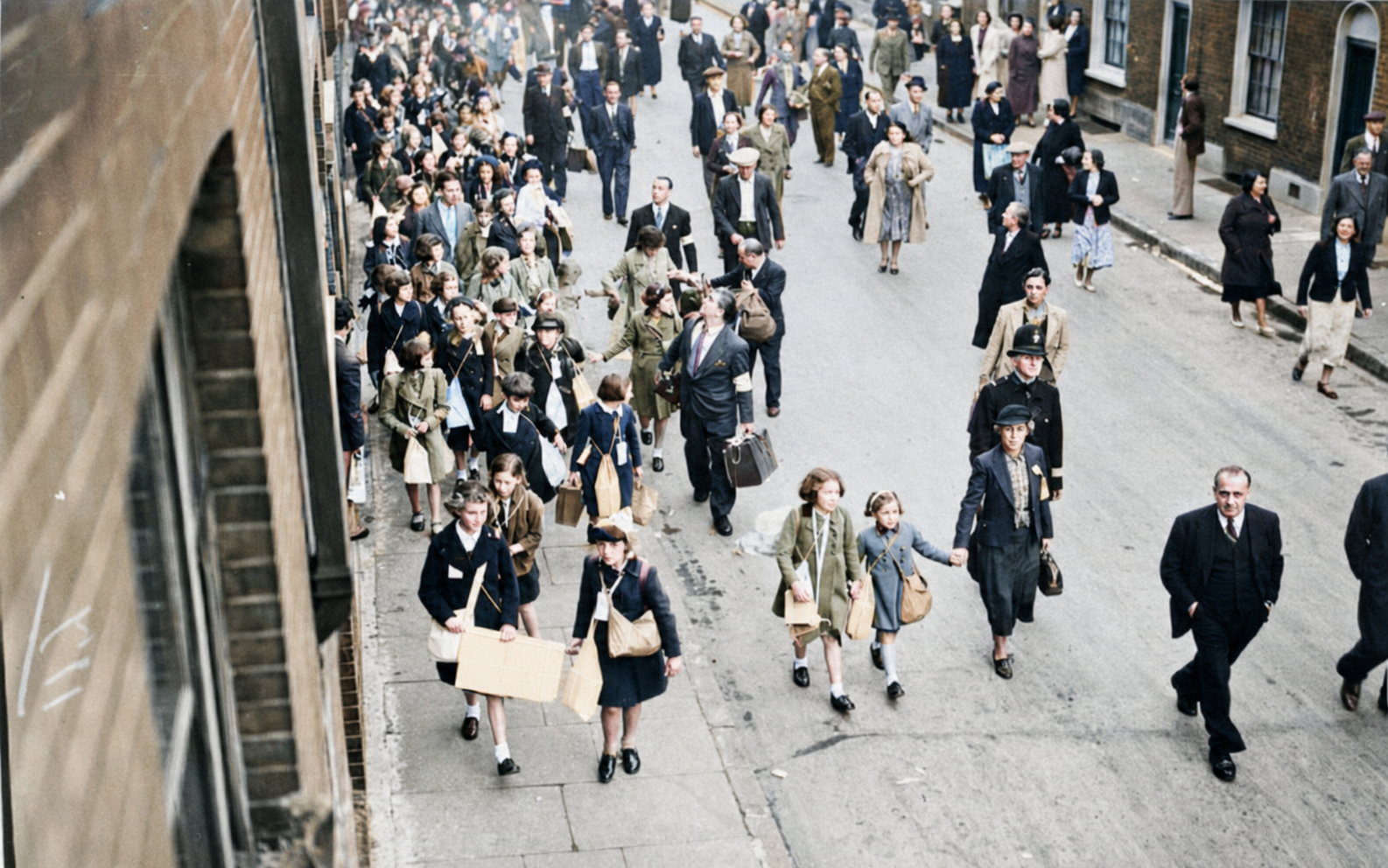
Evacuation begins: 1.5 million to leave the cities this week

The London Sentinel
Children carrying suitcases and small cardboard boxes on strings, walking in a line beside adult marshals.
Children leaving for the country, Stepney. Colourised from original Ministry of Information photograph. Photograph: Ministry of Information Photo Division photographer. Public domain (Crown copyright expired).

The children came onto the platform in twos, in long lines, a teacher at the front of each and another at the back.

They were from East End schools. Every child had a label pinned to a coat and a small cardboard box on a string over one shoulder. The boxes are gas masks. The labels are names and school numbers.

The trains are ordinary suburban stock. Nobody has told the children where they are going. In most cases nobody has told the parents either, which is deliberate, and is explained as a matter of order and security.

By 09:00 the platform was empty again except for what gets left behind: a glove, sandwich paper, a single shoe nobody came back for. More trains are due through the day.

Communiqué

President Mościcki proclaims state of war

Allied Press Service
The proclamation of President Moscicki, Warsaw. Reproduced from the original document. Proclamation by Ignacy Moscicki. Source: scan of the original document, collection of Janusz Szrom. Public domain.

President Ignacy Mościcki has proclaimed a state of war in Poland this morning, following the German attacks reported since dawn. The proclamation is made under the Constitution of the Republic, as a measure of national defence. United Press renders the proclamation's closing line as follows.

Official textOffice of the President of the Republic of Poland

The entire Polish nation, blessed by God, will march to victory.

Wire

Bombing reported across Polish towns

Allied Press Service

Bombing has been reported over a number of Polish towns and cities since first light this morning, according to reports reaching London. Anti-aircraft guns have engaged German aircraft over the capital on several occasions since dawn.

Polish and Allied sources describe the attacks as striking open towns; no German statement on the air operations has yet been received in London, and the full extent of the raids and any casualties cannot yet be confirmed. Communication with the Polish interior remains intermittent.

Wire

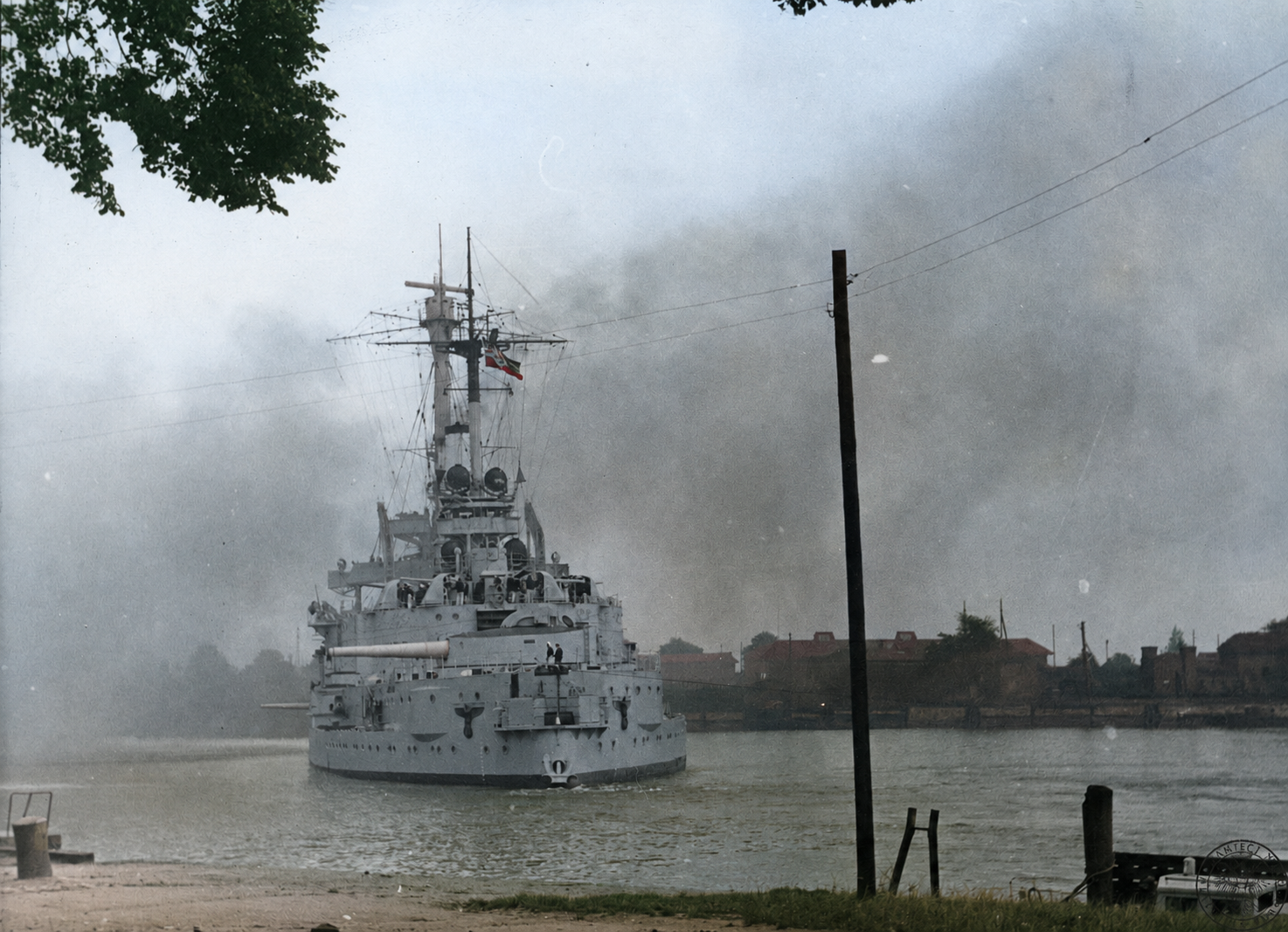
Danzig proclaimed part of the Reich; Westerplatte under fire

Allied Press Service
A battleship lying close to a low riverbank, with smoke rising beyond the far shore.
The battleship Schleswig-Holstein, Danzig. Colourised from original Polish archive photograph. Photographer unknown. Source: Instytut Pamieci Narodowej. Public domain.

The Free City of Danzig has been proclaimed part of the German Reich. Gauleiter Albert Forster announced the incorporation in the small hours of this morning, as Polish positions at the Westerplatte transit depot came under attack from German land and naval forces.

Poland has not recognised the annexation, and the outcome at Westerplatte is not yet known. A United States consular report records notification from the Danzig Senate that hostilities began shortly before five o'clock this morning.

BreakingWire

Germany invades Poland at dawn

Allied Press Service

German forces crossed the Polish frontier at several points in the first light of dawn this morning, striking from East Prussia, from Pomerania and Silesia, and from the south, where Slovak units are reported to be taking part. Bombing has been reported over Warsaw and other Polish towns.

The scale of the advance cannot yet be confirmed, and the German government has not yet issued a formal statement. Reuters and the Associated Press report the attacks from Warsaw and Berlin, and the Polish government's own communiqué confirms that fighting is under way along the frontier.

Communiqué

German radio: Poles attacked Gleiwitz station

Allied Press Service
Upper Silesia and the German-Polish frontier, showing Gleiwitz and its radio transmitter. Map: LIVE WW2.

The German state news agency DNB reports that Polish attackers seized the German radio transmitter at Gleiwitz, in Upper Silesia, on Thursday evening. The five-sentence item below, datelined Breslau and carried on the agency's wire late last night, is DNB's own account. It has not been independently confirmed, and foreign correspondents have not been permitted to inspect the scene.

Official textDeutsches Nachrichtenbüro (DNB)
State media

German state-controlled source, not independently verified.

Breslau, 31. August. (DNB.) Etwa um 20 Uhr am Donnerstag wurde der Sender Gleiwitz durch einen polnischen Ueberfall besetzt. Die Polen drangen mit Gewalt in den Senderraum ein. Es gelang ihnen, einen polnischen Aufruf in polnischer und zum Teil in deutscher Sprache zu verlesen. Sie wurden aber schon nach wenigen Minuten von der Polizei überwältigt, die von Gleiwitzer Rundfunkhörern alarmiert worden war. Die Polizei mußte von der Waffe Gebrauch machen, wobei es auf Seiten der Eindringlinge Tote gegeben hat.

(Translation.)

Breslau, 31 August. (DNB.) At about 8 o'clock on Thursday evening the Gleiwitz transmitter was occupied in a Polish raid. The Poles forced their way into the transmitter room. They succeeded in reading out a Polish proclamation, in Polish and partly in German. After only a few minutes, however, they were overpowered by police, who had been alerted by Gleiwitz listeners. The police were obliged to use their firearms, and there were dead among the intruders.

The day in pictures

A battleship lying close to a low riverbank, with smoke rising beyond the far shore.
The battleship Schleswig-Holstein, Danzig. Colourised from original Polish archive photograph.Photographer unknown. Source: Instytut Pamieci Narodowej. Public domain.
The proclamation of President Moscicki, Warsaw. Reproduced from the original document.Proclamation by Ignacy Moscicki. Source: scan of the original document, collection of Janusz Szrom. Public domain.
Children carrying suitcases and small cardboard boxes on strings, walking in a line beside adult marshals.
Children leaving for the country, Stepney. Colourised from original Ministry of Information photograph.Photograph: Ministry of Information Photo Division photographer. Public domain (Crown copyright expired).
A wide view of a speaker at a lectern addressing a chamber of uniformed and civilian members beneath large emblems.
Chancellor Hitler addressing the Reichstag, Berlin. Colourised from original German Federal Archives photograph.Bundesarchiv, Bild 183-E10402 / CC BY-SA 3.0 DE. Colourised derivative by LIVE WW2, released under the same licence.
Troops in position around a large municipal building during an assault, smoke visible at street level.
The attack on the Polish Post Office, Danzig. Colourised from original Polish archive photograph.Photographer unknown. Source: Apoloniusz Zawilski, Bitwy Polskiego Wrzesnia. Public domain.

Where things stood at the start of the day

Poland
Poland ordered general mobilisation on Wednesday, held it back a day at the urging of London and Paris, and posted it on Thursday. Berlin says it asked for a Polish emissary by Wednesday midnight and that none came; neither government calls it war.
Danzig
Gauleiter Albert Forster was made head of state on 23 August, an office the Free City's constitution does not contain. The German training ship Schleswig-Holstein has lain in the harbour since 25 August, within sight of Westerplatte, and no shot has been fired.
Britain at home
The Admiralty ordered the mobilisation of the fleet on Thursday, and merchant shipping has been under its direction since Saturday. Evacuation of schoolchildren, mothers with infants and the infirm from the cities begins on Friday morning, under a scheme built for three million people.
Western Front
France has been calling up reservists since 24 August and has manned the frontier fortifications, but has not ordered general mobilisation. Neither Paris nor London has delivered an ultimatum or set a deadline.
The Empire
The Anglo-Polish Agreement of Mutual Assistance was signed on 25 August, turning the spring guarantee into a treaty. Australia and New Zealand say that if Britain is at war they are; Mackenzie King says Canada's Parliament will decide, and Dublin intends to stay neutral.
Neutrals
Germany and the Soviet Union signed a non-aggression pact in Moscow on 23 August, ratified by the Supreme Soviet on Thursday. Roosevelt has appealed to Hitler, Mościcki and the King of Italy for a settlement; Mussolini has not said what Italy will do.
Background · Anglo-Polish guarantee

Why Britain is bound to Poland

In March, Britain guaranteed to come to Poland's aid if her independence were threatened. That guarantee is now being tested.

Britain's promise to Poland is five months old. On 31 March the Prime Minister told the Commons that if anything happened which clearly threatened Polish independence, and the Polish government thought it vital to resist, His Majesty's Government would feel bound at once to lend the Polish government all support in their power.

The wording matters. The promise is not triggered by any attack, but by action that clearly threatens Poland's independence. And it is Warsaw, not London, that decides whether resistance is vital. Britain agreed in March to take the Polish government's word for that.

At first the promise ran one way only. Britain gave it, and Poland gave nothing in return. That changed in early April, when the Polish Foreign Minister came to London and both governments agreed to make it mutual and put it into a treaty. The talks took the summer. Germany and the Soviet Union signed their pact of non-aggression in Moscow on the Wednesday of last week. Two days later, a week ago today, Britain and Poland signed the Agreement of Mutual Assistance in London. Under it each country comes to the other's aid if either is drawn into fighting with a European power that has attacked it.