Skip to the day
LiveWW2The Second World War, in real time
Day 2
Saturday 2 September 1939

Poland fights alone as London and Paris struggle to fix a deadline

From the LIVE WW2 feed

The day in dispatches

Filed through the day, as it happened
Newest first
Summary

Close of day: Poland fights on, Britain's answer promised at noon

Poland continues fighting on the second day of the German invasion, with resistance reported at Westerplatte and across multiple fronts, though no confirmed picture of the front line is available at this hour from either side.

No reply has been received from Berlin to the warnings delivered by Britain and France. Prime Minister Chamberlain told the House of Commons this evening that he expects to give a definite statement when Parliament reconvenes at noon tomorrow, without specifying its content. The statement followed a heated debate in which members from across the House pressed the government over the continuing delay, with Labour's Arthur Greenwood and the Liberal leader Sir Archibald Sinclair among those speaking most forcefully.

Britain has stated that it does not recognise Germany's incorporation of Danzig into the Reich. France's general mobilisation has reached full effect. Ireland has declared a national emergency and affirmed its neutrality. Britain's evacuation of children from vulnerable cities, and its blackout regulations, both continue into a second night.

Parliament reconvenes at noon tomorrow.
Editorial

Poland has been fighting alone for two days, and the Commons could not say for how much longer

The London Sentinel

Poland is fighting the war Britain and France promised to help it fight. It has been fighting it for two days, alone.

Nothing said in the Commons this evening changes that, however much was said and however forcefully. The Prime Minister told members no reply has come from Berlin, that discussions with France continue, and that an answer will be given tomorrow. All of that may be true. None of it alters what is happening tonight in Warsaw, in Kraków and at Westerplatte, where men are being killed by an army whose government Britain has now warned twice with no visible effect.

Eyewitness

Commons erupts: "Speak for England, Arthur"

The London Sentinel

Leo Amery's voice cut across the chamber before Arthur Greenwood had spoken a word. "Speak for England, Arthur!" The words carried the length of a packed and overheated House, and for a moment even the customary murmur of the benches fell quiet.

Greenwood, rising to answer for the Labour party in the absence of Attlee, who is recovering from an operation, had not expected the interruption, though he can hardly have been surprised by the sentiment behind it. Members have spent two days watching Poland bombed while waiting for their own government to say what it intends to do.

Wire

Britain refuses to recognise Danzig's annexation

Allied Press Service

Britain does not recognise Germany's incorporation of Danzig into the Reich, Prime Minister Chamberlain told the House of Commons this evening, rejecting both the German decree of annexation and the legal effect Berlin has sought to give it.

Danzig, a Free City under League of Nations protection since the last war, was declared reunited with Germany within hours of the invasion's opening yesterday. Chamberlain's statement makes clear that Britain regards the change as having no standing in international law, whatever practical control Germany now exercises on the ground.

No mechanism exists to reverse German control of the city in the near term. The statement establishes Britain's legal position, and practical control of the city stays where it is.

Communiqué

Chamberlain to the Commons: "no reply has been received"

Allied Press Service

The Prime Minister, Neville Chamberlain, addressed the House of Commons this evening on the position between Britain and Germany, close to forty hours after the German invasion of Poland began. He told members that His Majesty's Government remains bound to act unless German forces are withdrawn from Polish territory, that discussions continue with the French Government on a common course, and that Britain does not recognise Germany's incorporation of Danzig. His statement on Berlin's continued silence follows below in the Prime Minister's own words.

Official textH.M. Government

Sir Nevile Henderson was received by Herr von Ribbentrop at half-past nine last night, and he delivered the warning message which was read to the House yesterday. Herr von Ribbentrop replied that he must submit the communication to the German Chancellor. Our Ambassador declared his readiness to receive the Chancellor's reply. Up to the present no reply has been received.

Correspondent

Close to forty hours in, London and Paris still haven't agreed a deadline

The Paris Dispatch

London and Paris are still working, close to forty hours after the invasion of Poland began, on a common position on what their guarantees now require. Both governments maintain publicly that Germany has to withdraw before anything can be negotiated.

Chamberlain told the Commons this evening that a good part of the difficulty is mechanical. Two allied governments working by telephone and cable rather than round one table can't, in his words, synchronise their thoughts and actions as fast as people in the same room. Whatever else is said about the delay, that problem is not invented.

French officials point to mobilisation, still running, and to the constitutional requirement that the Chamber of Deputies approve war credits before a declaration. Neither requirement is unique to France. Both take days.

Wire

Blackout and air-raid precautions tighten across Britain

Allied Press Service

Britain entered a second night under blackout regulations, with households, shops, vehicles and public buildings again required to cover or extinguish all lights after dark.

Air Raid Precautions wardens patrolled streets across the capital and other cities to enforce compliance. The population continues to be instructed to carry gas masks at all times. Britain is still formally at peace.

Correspondent

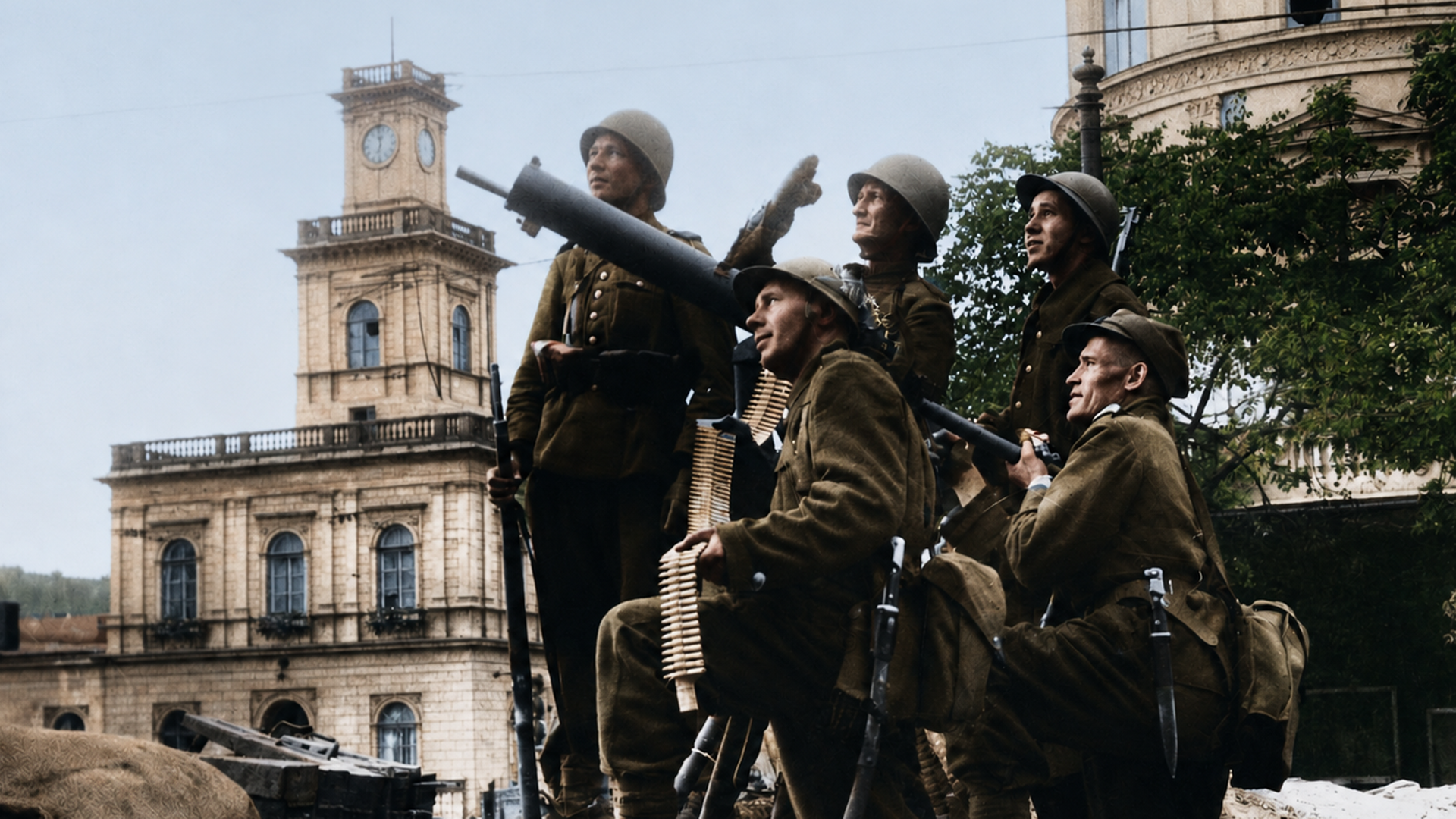
Warsaw and Kraków bombed again, with no reliable count of anything

Allied Press Service
Polish anti-aircraft soldiers in helmets man a machine-gun position against a Warsaw city backdrop.
A Polish anti-aircraft unit, Warsaw. Colourised from original National Digital Archive photograph. Defenders of Warsaw, 1939. Central Photographic Agency Warsaw. Narodowe Archiwum Cyfrowe, 37-110. Public domain.

More is coming through about today's air attacks on Warsaw and Kraków, though the gaps are still wide and official figures from both sides need treating carefully.

German aircraft hit both cities again through the day. Polish sources describe damage running into residential districts as well as rail junctions and other targets more easily called military. German statements say operations are directed only at military and communications objectives. Polish and French sources dispute that.

Kraków is closer to the German frontier and has been a target since the first hours. Reports from the city describe conditions getting worse rather than better as the second day goes on. Warsaw, further back, has had less than the cities near the frontier so far, though today's reports suggest that gap is closing.

Correspondent

Canada recalls parliament to decide on war for itself

The Imperial Review

Canada has recalled its parliament rather than let any British decision for war bind it automatically. In 1914 no separate Canadian decision was required.

A special session is fixed for next week. Parliament will vote on what part Canada takes if Britain goes to war. Mackenzie King's government has given no sign the outcome is in doubt. Under the Statute of Westminster, Canada goes to war by a decision made in Ottawa, not as an automatic consequence of one made in London.

That is not what happened in 1914, when the Empire went to war as one thing and the Dominions followed without being asked. Two decades of constitutional change, formalised in 1931, are being tested under an actual European war for the first time.

Correspondent

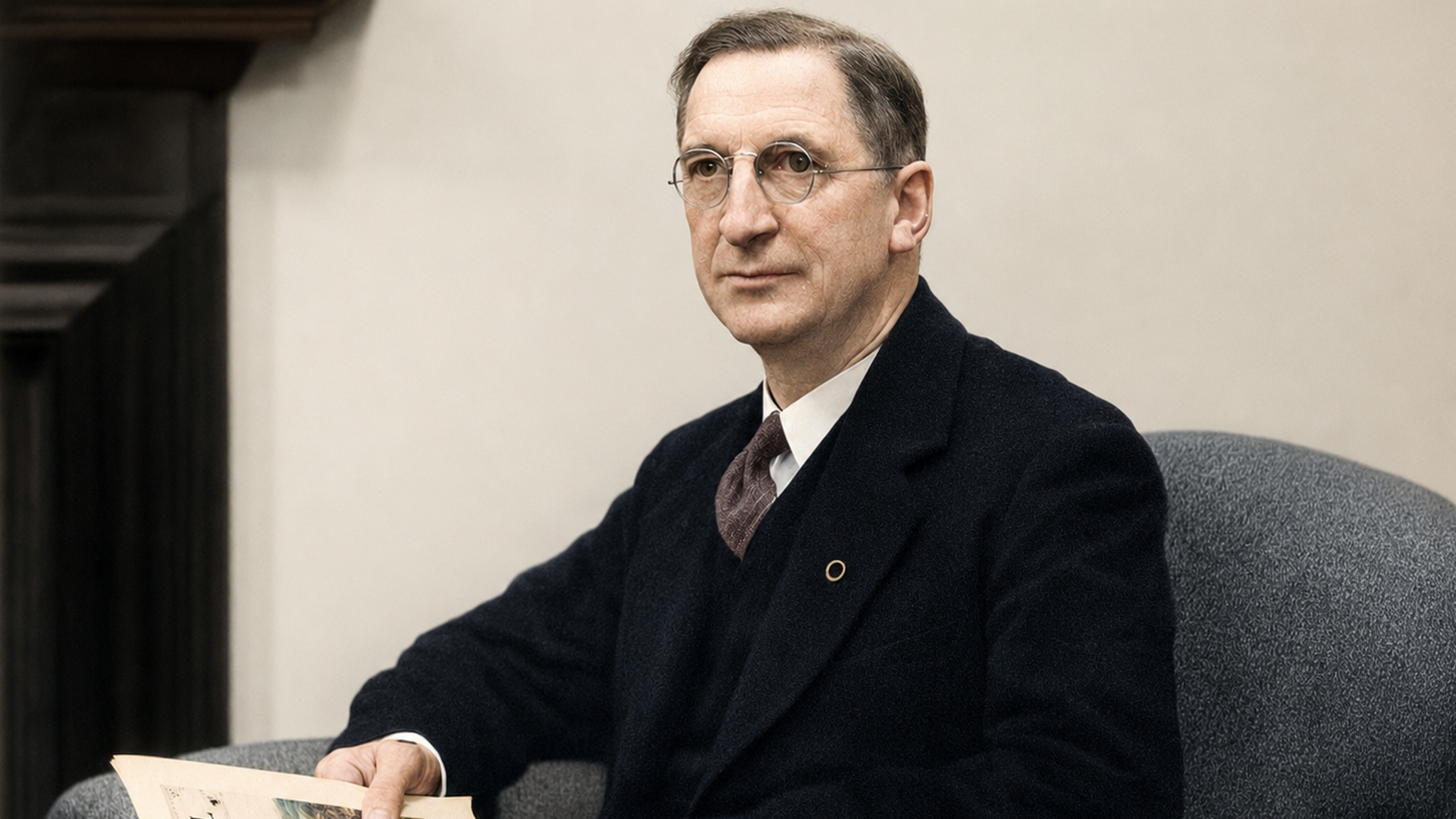
Ireland declares an emergency, and declares it will not join Britain's war

The Imperial Review
A portrait of Eamon de Valera in a dark suit, seated and looking away from the camera.
Eamon de Valera, Dublin. Colourised from original Irish press photograph. Photographer unknown, Irish press. UCD Digital Library, ivrla:31220. Public domain.

Ireland declared a state of national emergency today and confirmed it will stay out of the war.

The Dáil approved the constitutional declaration this afternoon on the government's motion. De Valera set out the case for strict neutrality regardless of what Britain does. The declaration gives the legal basis for emergency powers the government is expected to take in the coming days, covering press censorship, shipping and supplies.

The debate went through without serious challenge to the government's position, which tells you how settled the neutrality question already was before the vote. Opposition speakers asked about supply and defence rather than about the principle.

Correspondent

Germany guarantees Norway's neutrality, on Germany's own terms

The Stockholm Observer

Germany has formally assured Norway it will respect Norwegian territorial integrity and neutrality, according to diplomatic sources, provided Norway stays strictly neutral in the war in Poland.

The assurance came through official channels and follows the pattern of German diplomacy toward the smaller neutrals since the invasion started: respect for sovereignty, conditional on behaviour Berlin judges for itself.

Whether Oslo reads it as reassurance or as pressure in polite language hasn't been made public. Norwegian officials have said nothing.

The obvious question is what such an assurance is worth when the same government is currently violating an equivalent commitment to Poland. Germany's guarantee to Norway rests on Germany's future conduct. There is no external check on it and none is proposed.

Summary

Midday: where the fighting stands

Where things stand at midday: the German invasion of Poland presses into its second day, with fighting continuing across multiple fronts and no confirmed halt to operations reported. Warsaw and Kraków remain under air attack, with communications from the interior still difficult and no reliable casualty figures available from either city.

The Westerplatte garrison in Danzig harbour has not surrendered, continuing to hold against renewed German assault. France's general mobilisation, ordered yesterday, has reached full effect this morning, with reservists reporting to depots across the country. In Britain, the evacuation of children and other priority groups from vulnerable cities continues into its second day.

Poland's government has formally invoked its treaty agreements with Britain and France, calling for military assistance. Neither government has yet issued a public response to the appeal, nor announced a joint position on Germany's continued refusal to withdraw its forces.

The House of Commons sits this afternoon.

Correspondent

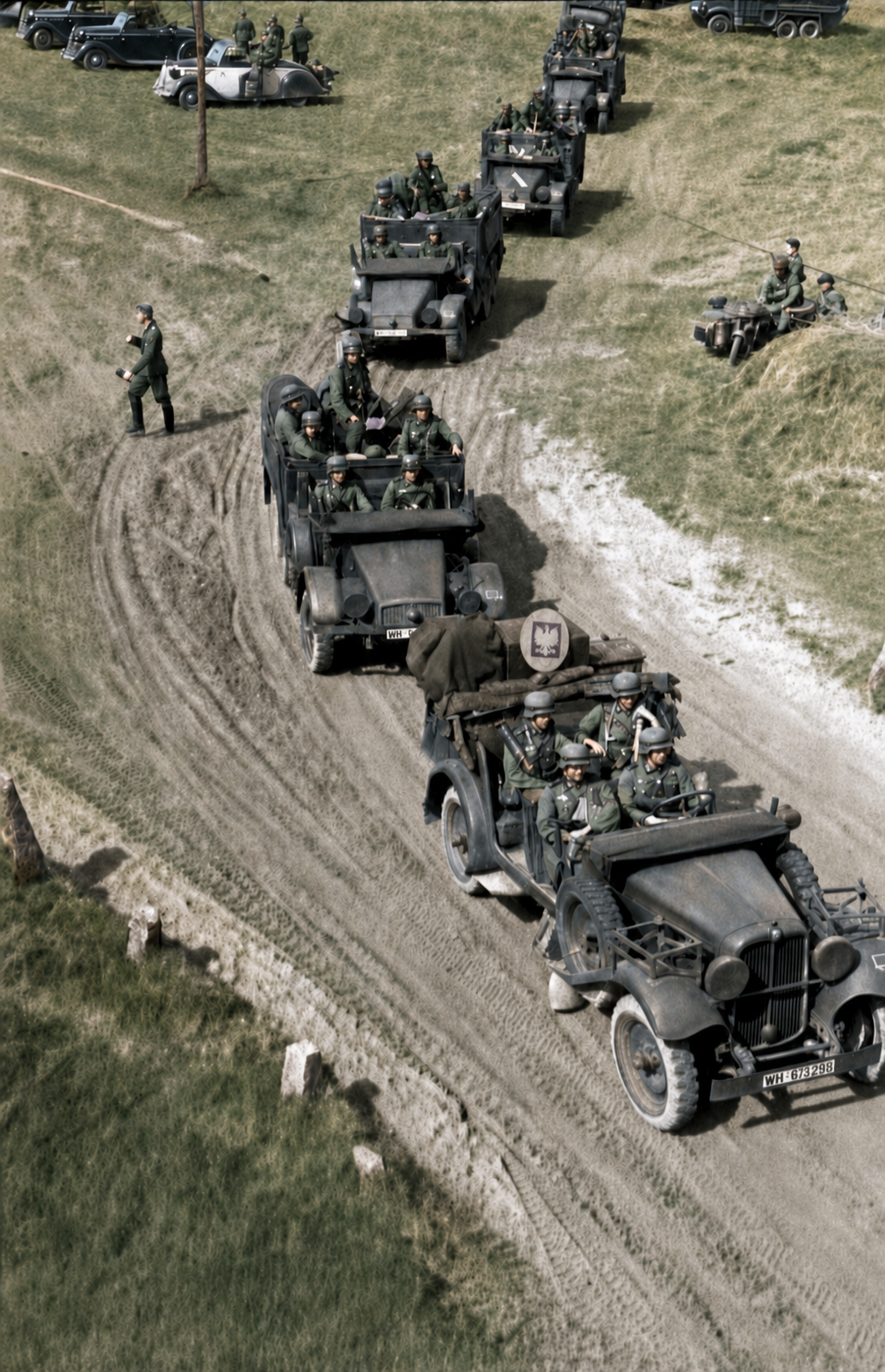
No reliable map of the Polish front can be drawn tonight

Allied Press Service
German motorised troops and vehicles form a long column on a rutted road through open Polish countryside.
A motorised German column, between Bagienica and Pruszcz, Poland. Colourised from original German Federal Archives photograph. Bundesarchiv, Bild 101I-121-0010-20 / CC BY-SA 3.0 DE. Colourised derivative by LIVE WW2, released under the same licence.

German forces pressed the attack across Poland through the second day, from East Prussia, Pomerania, Silesia and Slovakia, with aircraft hitting communications and towns inland.

How far the Germans have got is the open question. That they are attacking in strength across the whole frontier is not.

Reports reaching Warsaw, Berlin, Paris and London put German forces in different places. Communications inside Poland are broken and both governments are censoring what leaves them.

German communiqués through the morning describe rapid advances on several fronts and claim heavy Polish losses. Polish sources report determined resistance and counter-attacks at points along the line, including engagements Berlin hasn't acknowledged. Neither set of claims can be checked from outside the fighting.

Correspondent

Rome proposes a ceasefire and a conference. Poland wasn't asked.

The Paris Dispatch

Italy has proposed stopping the fighting in Poland and convening a conference of five powers, according to reports reaching Paris from Rome this morning.

Ciano put it forward for Mussolini. Britain, France, Poland, Germany and Italy would meet to settle Danzig and the Corridor, on the Munich model.

Munich is the problem with it. That conference stopped a war in central Europe by handing over what couldn't otherwise be justified. This time the war has already started, and any conference would sit while Poland is being invaded.

French officials got the proposal through diplomatic channels overnight and are understood to be testing it seriously. That's not hard to explain. This government has staked a lot on the argument that time spent finishing mobilisation and clearing civilians out of Paris and the eastern departments is time well spent. A conference that goes nowhere still buys days.

Wire

Warsaw, Kraków reported under fresh air attack

Allied Press Service

Warsaw and Kraków have come under renewed German air attack, according to reports reaching Paris, as the assault on Polish cities continues into a second day.

Communications from the interior remain unreliable, and no confirmed casualty figures are available from either city. Polish and German accounts differ sharply on the nature of the targets struck, with Warsaw sources describing damage to residential districts and German statements insisting operations are directed solely against military and communications objectives.

Neither government has offered an estimate of the scale of damage. Kraków, closer to the frontier, has been under attack since the first hours.

Eyewitness

The school is still open. There are eleven children in it.

The London Sentinel

The bell went at 09:00 at a school in Bethnal Green and eleven children came in.

There are places for about four hundred. Most of them went yesterday and the day before, in twos, with labels on their coats. The rest are here because their parents didn't sign the form, or changed their minds at the gate, or work shifts that made getting to the station impossible.

The head teacher has put them all in one room. The younger ones are at the front. She is teaching them together because there is no sensible way to run eleven children across seven classes, and because two of her staff went with the trains as escorts and have not come back yet.

Eyewitness

They are taking the vans first, and writing receipts for them

The Paris Dispatch
France's general mobilisation order, France. Restored from original French National Archives document. Ordre de mobilisation generale, 1939. French government. Archives nationales, CP/72AJ/724. Public domain.

The requisition officer at the mairie has a table, a rubber stamp, and a queue of men who have brought him their vehicles because a notice told them to.

He takes the registration book, checks it against a list, writes out a receipt and hands it over. The receipt says the Republic has taken the vehicle and will return it or pay for it. Nobody in the queue this morning asked which.

They are taking commercial vehicles first. Vans, small lorries, anything with a flat bed. A baker who arrived at 09:20 with a Citroën van explained twice, to two different officials, that he uses it for deliveries. Both agreed that he did. He filled in the form.

Correspondent

Westerplatte still hasn't fallen, and nobody outside can tell you why

Allied Press Service

The Polish garrison at Westerplatte has not surrendered. That is the second day it has not surrendered, and it is the only part of Danzig still contested.

German naval guns, artillery and aircraft went at the peninsula again through today, continuing a bombardment that started with the first shots of the war. As of this evening the depot is still in Polish hands.

No correspondent can get to Westerplatte. Danzig is under German control and everything coming out of it has been through either a German or a Polish channel, neither checkable from here. German communiqués claim steady progress. Polish sources say the garrison is holding. Both are claims.

Wire

German offensive continues through the night

Allied Press Service

German forces continued operations across the Polish frontier through the night, with no indication that Berlin intends to halt the invasion in response to the British and French warnings delivered last night.

Reports reaching Western capitals describe fighting continuing on several fronts, though communications from the interior remain difficult and precise details are not available. Both German and Polish sources issued claims overnight that could not be independently verified.

Correspondents in Warsaw report the city remained under alert through the night. Further details are expected as the day continues.

Wire

Poland invokes its alliances, appeals to Britain and France

Allied Press Service

Polish officials in London say Warsaw has formally invoked its treaty agreements with Britain and France, calling for immediate military assistance against the German invasion now in its second day.

Polish representatives told correspondents that the appeal follows directly from the alliances signed earlier this year, though the precise wording of the request has not been made public. Neither the British nor the French government has yet issued a formal reply to the appeal.

Warsaw's diplomats have pressed their case in both capitals since the invasion began. What assistance, if any, follows beyond the warnings already delivered to Berlin remains undisclosed this morning.

The day in pictures

France's general mobilisation order, France. Restored from original French National Archives document.Ordre de mobilisation generale, 1939. French government. Archives nationales, CP/72AJ/724. Public domain.
German motorised troops and vehicles form a long column on a rutted road through open Polish countryside.
A motorised German column, between Bagienica and Pruszcz, Poland. Colourised from original German Federal Archives photograph.Bundesarchiv, Bild 101I-121-0010-20 / CC BY-SA 3.0 DE. Colourised derivative by LIVE WW2, released under the same licence.
Polish anti-aircraft soldiers in helmets man a machine-gun position against a Warsaw city backdrop.
A Polish anti-aircraft unit, Warsaw. Colourised from original National Digital Archive photograph.Defenders of Warsaw, 1939. Central Photographic Agency Warsaw. Narodowe Archiwum Cyfrowe, 37-110. Public domain.
A portrait of Eamon de Valera in a dark suit, seated and looking away from the camera.
Eamon de Valera, Dublin. Colourised from original Irish press photograph.Photographer unknown, Irish press. UCD Digital Library, ivrla:31220. Public domain.

Where things stood at the start of the day

Poland
Germany invaded Poland at first light on Friday from East Prussia, Pomerania, Silesia and Slovak territory, with bombing reported over Warsaw from dawn. President Mościcki has proclaimed a state of war; how deep the advance has gone cannot be established from any capital.
Danzig
The Free City has been proclaimed part of the Reich; neither Poland nor the League recognises it. The Polish garrison at Westerplatte came under fire before five on Friday morning and was still under attack at nightfall.
Britain at home
Britain has not declared war; Chamberlain has warned Berlin that unless Germany suspends its action and withdraws, the government will fulfil its obligations to Poland. Evacuation trains began leaving London at 09:00 and the first blackout took effect at dusk.
Western Front
France has ordered general mobilisation and delivered a warning to Berlin parallel to Britain's, without a fixed time limit. Hitler told the Reichstag that bombs will be met by bombs, and named Göring, then Hess, as his successors.
Neutrals
Italy will take no military initiative for now: Rome asked to be released from the military obligations of the Pact of Steel and Berlin agreed within hours. Roosevelt has asked five governments to pledge not to bomb civilians, and none has answered.
Background · Anglo-French declaration mechanics

The guarantee, explained: how a promise to Poland becomes a declaration of war

Britain and France each promised to defend Poland if attacked. Neither promise is a declaration of war by itself — here is what actually has to happen first.

Britain and France each promised, months before the invasion began, to come to Poland's aid if Germany attacked. Neither promise translates automatically into a declaration of war, and readers wondering why a day has passed without one may find the answer less in hesitation than in mechanism.

The 31 March guarantee. Britain's commitment, given to Poland on 31 March, obliges the government to lend Poland "all support in their power" in the event of any action which clearly threatened Polish independence and which the Polish government considered it vital to resist. It is a serious and binding commitment. It is not, however, a declaration of war in itself, and does not become one without a further, separate act.