Skip to the day
LiveWW2The Second World War, in real time
Day 3
Sunday 3 September 1939

Britain and France declare war on Germany; Poland fights on

From the LIVE WW2 feed

The day in dispatches

Filed through the day, as it happened
Newest first
Summary

What we know at the close of the third day

At the close of the third day of the war, the position is this. Britain has been at war with Germany since eleven o'clock this morning; France, since five o'clock this afternoon, Paris time. Germany's rejection of Britain's ultimatum, received shortly after the deadline passed, offered no reconsideration, only a formal statement of refusal.

Across the Empire, Australia, India and New Zealand stand with Britain; South Africa's Parliament will decide tomorrow, with the Government's own survival now bound to the outcome. Ireland has confirmed its neutrality. In Poland, the German offensive continues into a fourth day tomorrow, with the Westerplatte garrison in Danzig harbour still holding and no Allied soldier yet on Polish soil.

Tonight brings two further, unresolved developments. RAF aircraft are over Germany at this hour on the war's first offensive air operation, their return not yet confirmed. And in the North Atlantic, the passenger liner Athenia has been struck by an explosion of undetermined cause; rescue efforts continue as this dispatch closes, with casualties, survivors and responsibility for the attack all still unknown.
Correspondent

A British liner has been hit in the Atlantic, hours after the declaration

Allied Press Service
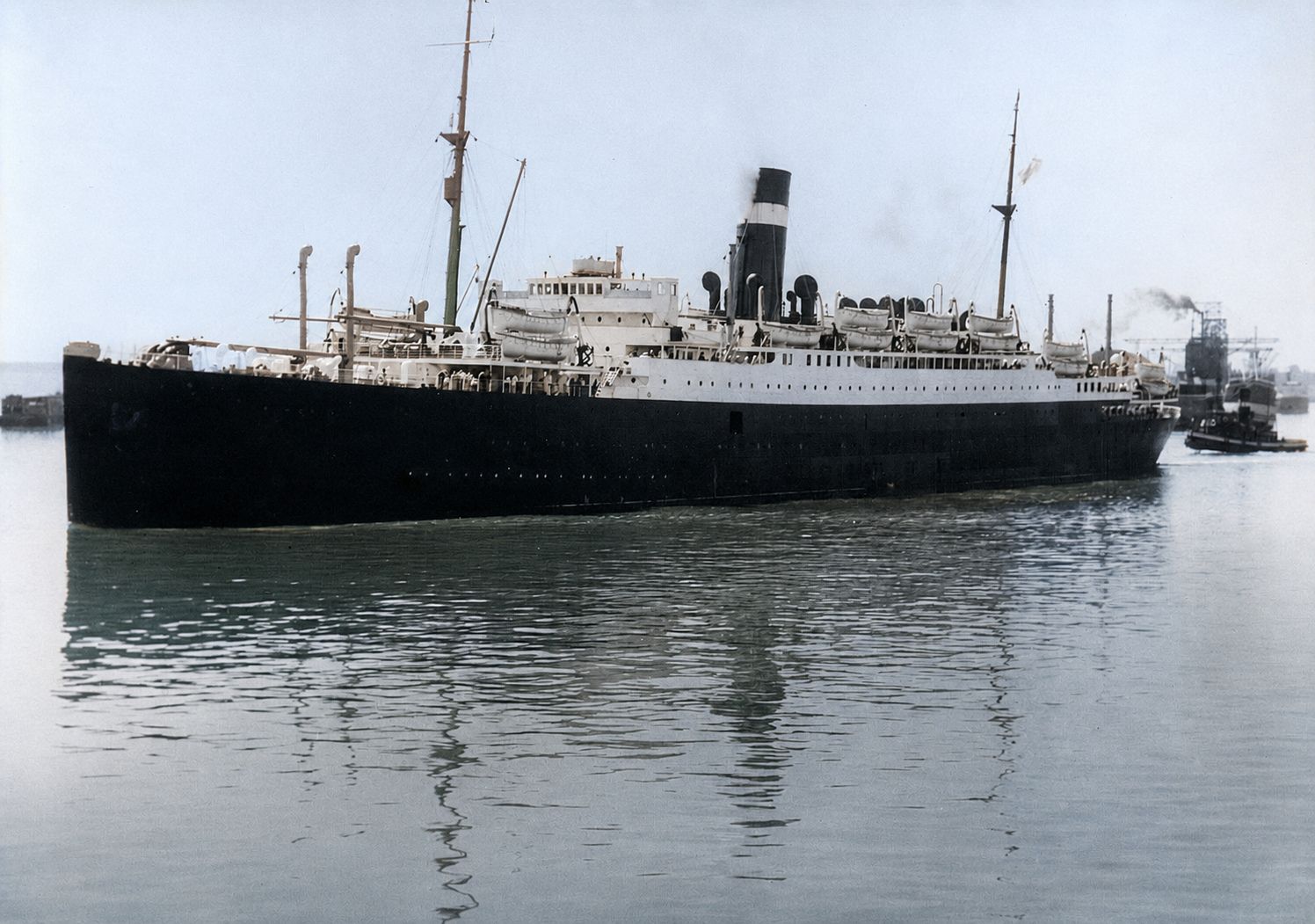
A single-funnelled passenger liner with a black hull and white superstructure moves through calm harbour water, a small tug close astern.
SS Athenia pictured in Montreal Harbour. Colourised from original Library and Archives Canada photograph. Photograph: C.M. Johnston, Clifford M. Johnston collection. Library and Archives Canada, PA-056818. Public domain.

A British passenger liner has been struck in the North Atlantic tonight, hours after Britain declared war.

The Athenia was sailing west from Liverpool with a large complement of passengers, including women and children, when an explosion hit her northwest of Ireland this evening. Distress signals brought merchant vessels toward the position and a rescue is under way as this is filed. She was still afloat at time of writing. Her condition isn't certain.

What caused the explosion isn't established. Early reports describe a torpedo or an underwater attack, which would mean a submarine. This correspondent cannot confirm that a German U-boat, or any German vessel, was responsible. Berlin has said nothing. London has said nothing beyond confirming that rescue vessels are responding.

Editorial

Britain kept its word today. Poland asked for something else.

The London Sentinel

London kept its word today. A guarantee given to Poland in March, when war was a possibility rather than a certainty, was honoured at the moment it mattered and without further delay once the deadline had passed. France did the same this evening. Whatever else is said about the diplomacy of the past week, that is now beyond argument.

It would be easier to stop there.

Poland didn't ask for declarations. Poland asked, two days ago and for months before that, for help against an invasion that was already happening. What it got today is a change in the legal and moral position of two great powers. The military position on the ground is exactly what it was yesterday.

Wire

RAF sends leaflets over Germany on the first night of war

Allied Press Service

RAF Bomber Command aircraft left bases in the north of England after dark tonight on the first British air operation over Germany of the war. The Air Ministry confirms the aircraft are carrying leaflets rather than bombs, addressed to the German population rather than German forces. No aircraft have yet been reported as returned. The Ministry has given no further detail on routes, numbers or targets, citing the operation's ongoing nature. A fuller account is expected once crews are back at their stations.

Correspondent

Ireland will not fight in this war

The Stockholm Observer

Ireland will not fight in this war. That was the substance of de Valera's broadcast this evening, delivered as the rest of these islands entered their first day of war with Germany.

Neutrality is now formal policy, backed by emergency legislation the Dáil approved yesterday. De Valera framed it as a matter of sovereignty and unity rather than sympathy for either side, a position his government has signalled clearly enough that tonight's address surprised nobody in Dublin.

The practical difficulty is geography. Ireland sits directly across the Atlantic shipping lanes Britain will depend on, and its coastline offers advantage to whichever belligerent can use it. London and Berlin will each have views about what Irish neutrality means for their war, and those views are less settled than the declaration itself.

Correspondent

The evacuation is nearly done, and it moved a third of the number planned

The London Sentinel

The platforms that were full of labelled children two days ago are largely empty tonight.

The government's evacuation scheme, which started before the declaration rather than after it, has moved something over a million people, mostly children, out of London and other cities judged likely targets, into billets across the countryside. Nearly all of those who set out have reached reception areas. By its planners' standards it worked.

It moved roughly a third of the number originally planned for. Not because the danger was reassessed, but because a great many families, given the choice, kept their children at home.

Situation map

Where the German advance stands, day three

The approximate front line in Poland at the close of the third day. Map: LIVE WW2.
Correspondent

The King broadcast to an Empire that has not answered with one voice

The Imperial Review

The King broadcast to Britain and the Empire this evening, calling his peoples to a war his ministers had already declared in his name.

He made no appeal to victory and offered no confidence in an early end. He asked for calm and endurance. "In this grave hour, perhaps the most fateful in our history," he told listeners, "I send to every household of my peoples ... this message." What followed was an appeal for calm, resolve and unity, addressed to Britain, Australia, Canada, New Zealand, South Africa, India and the colonial territories at once.

The Empire it reached has not answered with one voice. South Africa's Parliament votes tomorrow. Ireland has declared neutrality. Canada recalls its own parliament. India was declared at war this morning without any Indian being asked.

Correspondent

South Africa doesn't know yet whether it is neutral or at war

The Southern Cross

South Africa doesn't know whether it is neutral or at war, and by the government's own admission won't know until Parliament votes tomorrow.

The split runs through the Cabinet. Hertzog argues the Union's interests are served by staying out of a European quarrel not of its making, a position with deep roots in Afrikaner politics and long scepticism of British imperial commitments. Smuts, his deputy and long-time rival, argues the opposite: that South African security and standing obligations point to breaking relations with Germany. Neither has persuaded the other. The Cabinet couldn't agree a single position to put to Parliament.

Correspondent

France enters the war after its own deadline expires

The Paris Dispatch

France is at war with Germany. The announcement came this afternoon, some hours after London's, and with far less public drama.

Ambassador Robert Coulondre delivered France's position to Ribbentrop directly: that France would be obliged to fulfil the obligations it had contracted towards Poland. From five o'clock this afternoon, Paris time, a state of war exists between the two countries. Ribbentrop's reply, reported through diplomatic channels, called France the aggressor. Coulondre rejected that on the spot, pointing to three days of German attacks on Polish territory.

France has mobilised, coordinated its ultimatum timing with London, and is now formally committed to a war the Daladier government says the treaty structure of the past two decades made unavoidable.

Summary

What we know by mid-afternoon

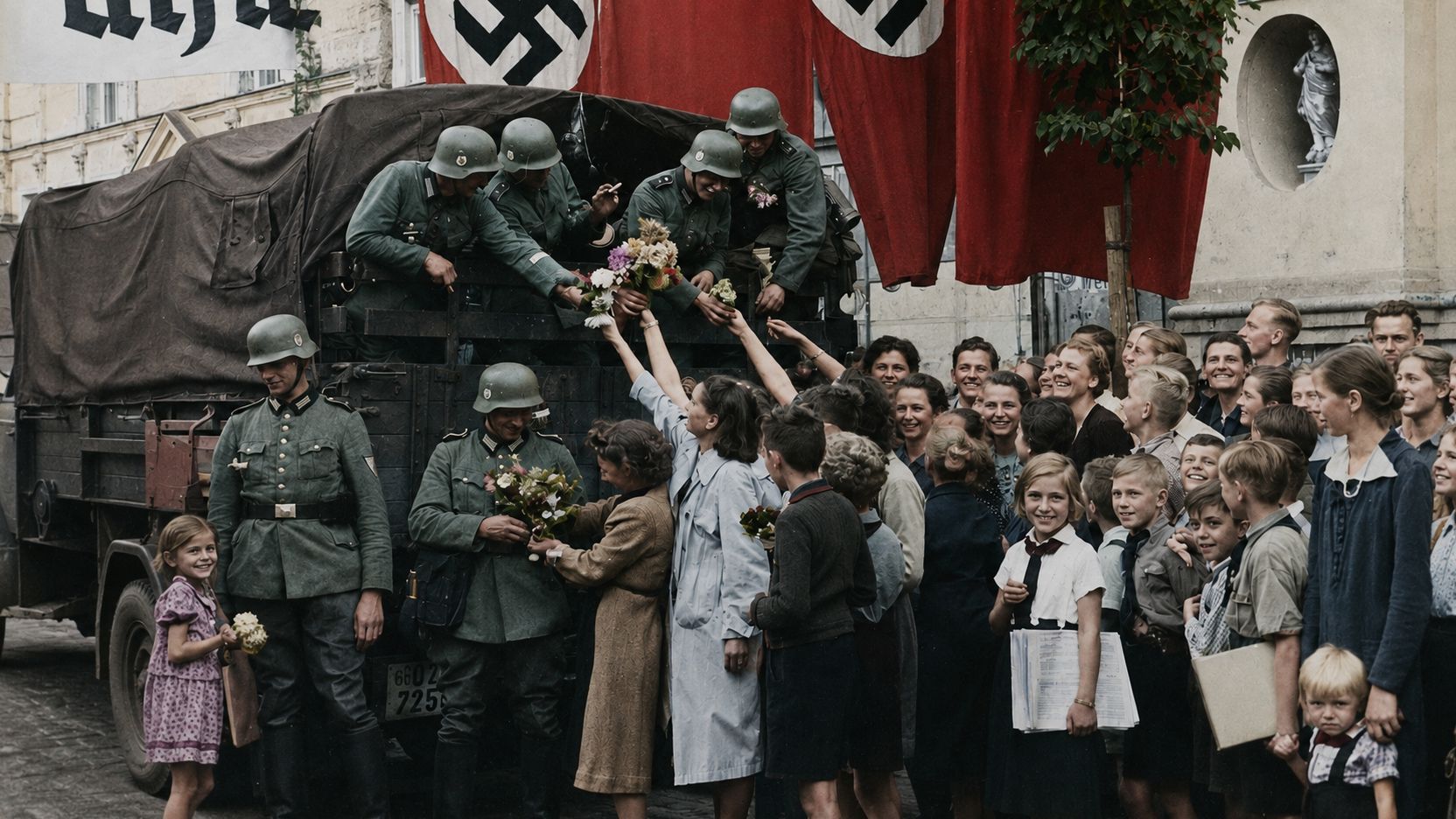
German soldiers on a truck receive flowers from civilians in a street hung with large Nazi flags.
German troops receive flowers from civilians beneath Nazi flags in Danzig. Colourised from original Rijksmuseum photograph. Atlantic (Titz. Fr. OKW). Rijksmuseum, NG-2006-52-8. CC0 1.0 Universal.

By mid-afternoon, the shape of the day is largely set, though its ending is not. Britain and Germany are at war, a state that has existed since eleven o'clock this morning; Berlin's formal rejection of the British ultimatum, received shortly after, has done nothing to change that. London's first wartime air-raid warning proved a false alarm, resolved before noon. Parliament has met, formed a new War Cabinet under Chamberlain with Churchill returning to the Admiralty, and passed emergency legislation extending liability for military service to men between eighteen and forty.

Financially, there is no market to report: the Exchange remains closed, and new wartime controls now govern currency and capital. In Rome, Italy's non-belligerence holds; the conference proposal that might have averted this outcome has been overtaken by events. Across the Empire, Australia and India are declared at war, the latter without consulting Indian political leaders. In Warsaw, the news of Britain's declaration has produced public demonstrations of relief, even as German attacks on Polish territory continue unabated.

France's deadline to Germany has not yet expired.

Correspondent

Italy is not at war, which is the only news out of Rome today

The Stockholm Observer

Italy is not at war, despite its formal alliance with Germany.

The position is unchanged from the non-belligerence declared some days ago. Mussolini's proposal for a five-power conference has been overtaken; there's no conference to hold once Britain and France have declared. Ciano has announced nothing altering the country's position.

Rome presents this as statesmanship, a last effort for peace frustrated by other people's haste. Officials in London and Paris take a different view privately: that Italy was never in a position to fight a general European war at short notice whatever the Pact of Steel says, and that the conference proposal was as much about appearing engaged as about mediating. Neither account can be verified from outside the governments concerned.

Correspondent

New Zealand's declaration is backdated to London's hour, deliberately

The Southern Cross

New Zealand is at war with Germany, the government confirmed late tonight Wellington time, in a declaration backdated to the moment Britain's own state of war began this morning.

New Zealand sits far enough ahead of London on the clock that announcing a declaration tonight could leave the impression the Dominion moved first. It didn't. Confirmation of Britain's declaration only reached Wellington late this evening, and the government's decision follows directly from it, dated to London's moment rather than Wellington's.

The decision itself was never contested here. Savage's government has treated New Zealand's obligations to Britain as self-evident since the crisis began, and tonight's confirmation formalises a position the country had already taken in every practical sense.

Eyewitness

Warsaw cheers outside the British Embassy. No Allied soldier is in Poland.

Allied Press Service

News of Britain's declaration got here by early afternoon and within the hour there was a crowd outside the British Embassy with hand-lettered banners. One read: "Long Live England."

It is relief more than celebration. Two days of bombing and unreliable news from the front have left this city wanting confirmation that its appeals to London and Paris weren't wasted. An elderly man selling papers near the Embassy gates said he'd waited two days to sell one with this headline on it.

No Allied soldier has set foot in Poland. None is expected soon. The declarations change Poland's diplomatic position and nothing else, and German forces are pressing the attack this afternoon exactly as they were this morning.

Correspondent

India is at war by proclamation. No Indian leader was asked.

The Imperial Review

India is at war with Germany by executive proclamation and nothing else. The Viceroy, Lord Linlithgow, declared it this morning under the authority of his office, without consulting a single elected Indian political leader.

The mechanism is plain under the Government of India Act. When the Crown is at war, the Viceroy may declare India at war without reference to the provincial ministries or the central legislature. That authority has now been used. Congress ministries govern a majority of Indian provinces. None was asked before several hundred million people were placed in a state of war.

India's political leadership has spent years pressing for a greater say in exactly this kind of decision. A declaration made entirely without them will sharpen that argument rather than soften it.

Correspondent

No market report today, because there is no market

The Atlantic Ledger

The London Stock Exchange has been shut since Friday, two days before the declaration, and Sunday would have kept it shut anyway. Anyone looking for a share-index fall caused by today's declaration won't find one. There was no session in which prices could move.

The change is in the machinery behind it. The Bank of England gave notice this morning that it will make temporary advances to approved banks so ordinary depositors can get currency while normal trading is suspended. Behind that sit new Defence (Finance) Regulations putting gold, foreign exchange, marketable securities and new capital issues under government control from today.

Wire

Parliament extends conscription across the male population

Allied Press Service

Parliament today passed emergency legislation making male British subjects between the ages of eighteen and forty liable for military service. The National Service (Armed Forces) Bill passed through the Commons and Lords in a single emergency sitting, replacing the limited peacetime training scheme introduced earlier this year. The Government has not yet announced call-up dates, medical categories, or exemptions. Implementation is expected to follow in stages rather than all at once.

Correspondent

Chamberlain's War Cabinet has nine members, and one of them is Churchill

The Imperial Review

Chamberlain's War Cabinet, announced to the House this afternoon, is deliberately small. Nine members against a peacetime Cabinet of more than twenty. The logic is speed.

The appointment that will draw most attention abroad is Churchill's return to the Admiralty, the office he held at the outbreak of the last war with Germany. He has spent most of the past decade out of government, attacking the policy of accommodation with Berlin from the back benches. He now runs the department responsible for the naval war.

The rest reads as continuity. Halifax stays at the Foreign Office, Simon at the Exchequer, Chatfield on defence coordination, Hore-Belisha at the War Office, Kingsley Wood at Air, Hoare as Lord Privy Seal. Hankey joins without portfolio, bringing decades of Committee of Imperial Defence experience.

Correspondent

Australia is at war, and nobody in Melbourne pretended the decision was open

The Southern Cross

Australia is at war with Germany. Menzies told the country shortly after 21:00 Australian time that Britain's declaration carries the Commonwealth with it. "Great Britain has declared war upon her," he said, "and, as a result, Australia is also at war."

The broadcast reached a country that fought the last European war at a cost still counted in nearly every town. The casualty lists of 1914 to 1918 are living memory here rather than history. Menzies didn't dwell on it beyond acknowledging what a second war within a generation asks.

What forces Australia commits, when, and to which theatre, isn't decided. The government says consultations on the scale of the contribution follow in the coming days.

Correspondent

The House that nearly broke the government last night closed ranks today

The Imperial Review

The Commons that met at noon today bore no resemblance to the one that nearly brought the government down last night.

The mechanics were quick. Chamberlain reported what members already knew from the radio: Germany hadn't answered the morning's ultimatum, and a state of war had existed since 11:00. The House ratified it rather than debated it.

Attlee pledged Labour's full support in what he called a struggle against aggression, a phrase broad enough to hold together a party that has argued for two years about the terms of British rearmament. Churchill, not yet back in office when he rose, told the House that the storms of war might blow outside but that in the hearts of members that Sunday morning there was peace.

Eyewitness

London's first wartime air-raid warning proves false

The London Sentinel

The sirens began less than half an hour after Chamberlain finished speaking. In Fulham the street emptied almost without noise. A woman pulled two children by the hand toward the nearest shelter sign without breaking stride. A man carrying a rolled newspaper folded it under his arm and walked, not ran, in the same direction. An ARP warden in a tin hat that still looked new stood in the middle of the road directing people who did not especially need directing.

For about twenty minutes this stretch of London waited underground for a raid that did not come. There was low talk, some of it about the broadcast, most of it about nothing.

Communiqué

Berlin's answer: Germany rejects the British demand

The Stockholm Observer

The German Government handed its formal reply to the British ultimatum to Ambassador Henderson shortly after the deadline passed. The document, issued through the German Foreign Ministry, rejects the British demand outright and presents the invasion of Poland as an act of self-defence. What follows is the German Government's own case, not verified fact.

Official textGerman Government (Auswärtiges Amt)
State media

German state-controlled source. Its account of the war's origins is the German Government's own and is not independently verified.

The German Government have received the British Government's ultimatum of the 3rd of September. They have the honour to reply as follows. The German Government and the German people refuse to receive, accept, let alone to fulfil, demands in the nature of ultimata made by the British Government. On our eastern frontier there has for many months already reigned a condition of war. The German Government, therefore, reject the attempt to force Germany, by means of a demand having the character of an ultimatum, to recall the forces lined up for the defence of the Reich. The German Government and the German people have assured the English people countless times how much they desire an understanding, indeed close friendship, with them. If the British Government hitherto always refused these offers and now answer with an open threat of war, it is not the fault of the German people and their Government, but exclusively the fault of the British Cabinet.

Eyewitness

The crowd in Downing Street came to stand near a door

The London Sentinel

By 11:30 the crowd outside Downing Street was too big for the pavement.

Men in bowler hats stood next to women who had left market queues unfinished when the news reached them. A policeman on horseback held the line at the entrance. There was almost no pushing.

Chamberlain had already spoken. His broadcast went out over wireless sets in every house within earshot of this crowd and in most of them nobody moved until he'd finished. Two women near the railings were crying and not hiding it. An elderly man in a raincoat said, to nobody in particular, that his son had fought at Passchendaele.

BreakingWire

Britain is at war with Germany

Allied Press Service

Britain is at war with Germany. The Prime Minister, Neville Chamberlain, told the country by radio shortly after eleven o'clock this morning that the German Government had failed to answer this morning's ultimatum by its deadline.

"Consequently, this country is at war with Germany," Chamberlain said. Britain's passports have been handed to the German Chargé d'Affaires in London, the formal diplomatic marker of the break. France is understood to be delivering a similar demand to Berlin, on its own deadline, under terms agreed between the two governments. No details of military operations have yet been given. A further statement is expected from the Government later today.

Communiqué

Britain's final ultimatum: the note delivered in Berlin

The London Sentinel

At nine o'clock this morning, British Summer Time, His Majesty's Ambassador in Berlin, Sir Nevile Henderson, delivered a final note to the German Government on the instructions of the Foreign Secretary, Lord Halifax, setting a fixed deadline of two hours for Germany to give the assurance Britain has sought since Friday. The operative passage of the note, as released by the Foreign Office, follows below.

Official textHM Government (British Foreign Office)

Although this communication was made more than twenty-four hours ago, no reply has been received, but German attacks upon Poland have been continued and intensified. I have accordingly the honour to inform you that, unless not later than 11 a.m., British Summer Time, to-day, the 3rd of September, satisfactory assurances to the above effect have been given by the German Government and have reached His Majesty's Government in London, a state of war will exist between the two countries as from that hour.

Summary

What we know at dawn

Three days into the German invasion of Poland, the position at dawn on Sunday is this. German forces continue to press their attack across Poland's western and northern approaches. Polish forces continue to resist, though a reliable picture of the front line is not available to correspondents here. The isolated Polish garrison at Westerplatte, on the Danzig waterfront, has not surrendered, entering its third day under siege.

In London, the British Government's warning to Germany, delivered on Friday and left unanswered since, still awaits a reply. Neither Berlin's silence nor Warsaw's resistance has changed overnight. The British Cabinet is due to meet again this morning.

Correspondent

Westerplatte is into a third day and the German communiqués say it is nearly over

The Stockholm Observer

The Polish garrison at Westerplatte was into a third day of resistance this morning, according to reports reaching Stockholm by way of Warsaw. The depot has been cut off since the first hours of the war and has not surrendered.

Not much beyond that can be established. Danzig has been under complete German control since the war began, and what comes out of it comes through German channels or through Polish channels reporting at a remove. No neutral correspondent has direct access to the depot.

Inside that limit the claims diverge. German sources describe the position as effectively neutralised and its resistance a matter of hours. Polish communiqués monitored from Warsaw describe a garrison still fighting from prepared positions, with casualties and supplies unknown outside the perimeter. Neither account checks the other.

Wire

German offensive continues into a third day

Allied Press Service
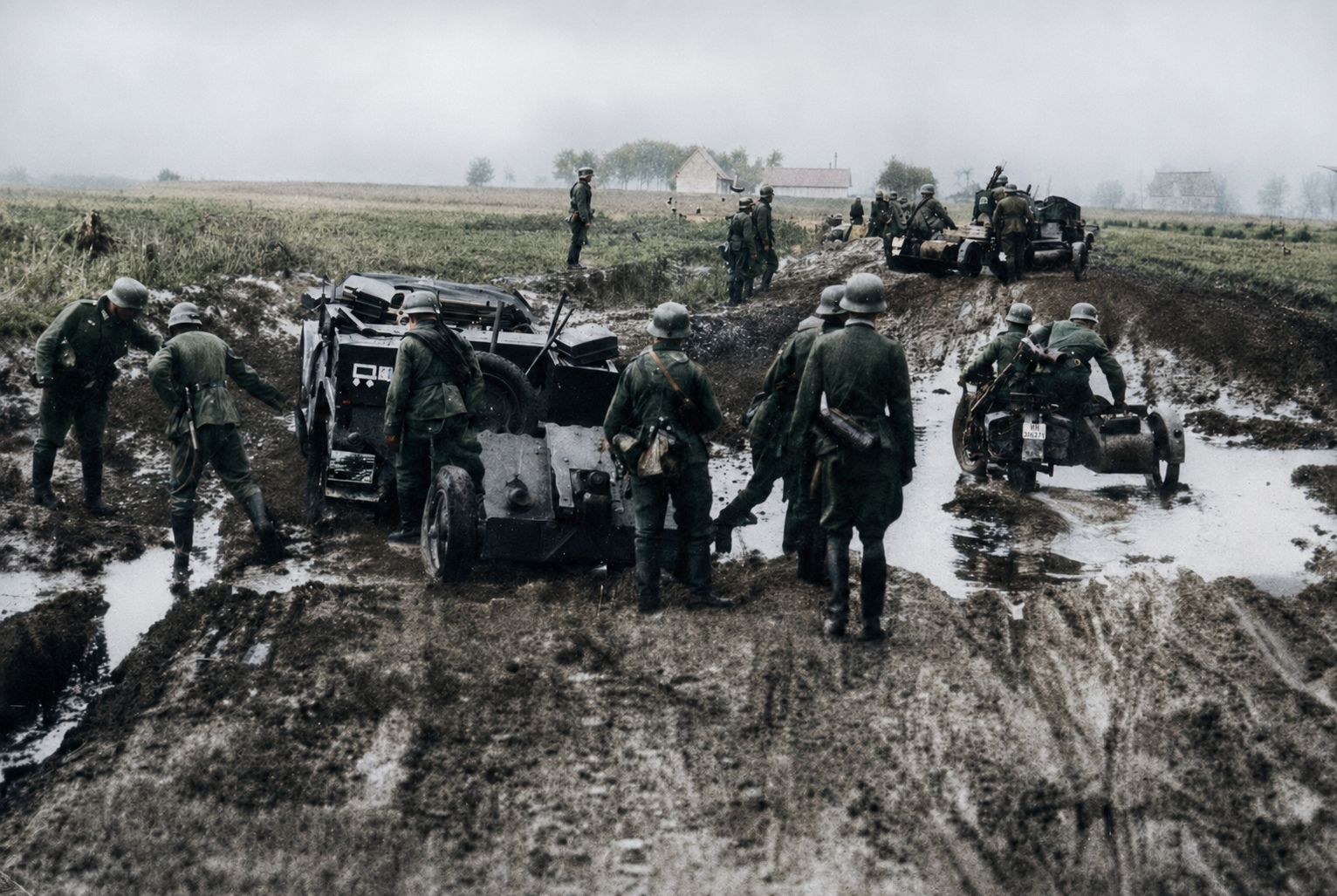
German soldiers, motorcycles and vehicles bogged down on a deeply rutted muddy road in Poland.
German motorised troops struggle along a rain-soaked road in Poland. Colourised from original Bundesarchiv photograph. Bundesarchiv, Bild 183-2008-0415-506 / CC BY-SA 3.0 DE. Colourised derivative by LIVE WW2, released under the same licence.

German forces pressed their invasion of Poland into a third day overnight, with fighting reported across the country's western and northern approaches. Polish commanders said their forces continued to resist, though communications remain disrupted and no reliable picture of the front line is available to correspondents.

German reports claimed rapid advances and encirclements. Warsaw's own communiqués spoke of continued resistance and local successes. Neither account can be independently verified. Both agree the fighting is continuing.

The day in pictures

German soldiers, motorcycles and vehicles bogged down on a deeply rutted muddy road in Poland.
German motorised troops struggle along a rain-soaked road in Poland. Colourised from original Bundesarchiv photograph.Bundesarchiv, Bild 183-2008-0415-506 / CC BY-SA 3.0 DE. Colourised derivative by LIVE WW2, released under the same licence.
German soldiers on a truck receive flowers from civilians in a street hung with large Nazi flags.
German troops receive flowers from civilians beneath Nazi flags in Danzig. Colourised from original Rijksmuseum photograph.Atlantic (Titz. Fr. OKW). Rijksmuseum, NG-2006-52-8. CC0 1.0 Universal.
The approximate front line in Poland at the close of the third day. Graphic by LIVE WW2, compiled from both sides' official claims.Map: LIVE WW2.
A single-funnelled passenger liner with a black hull and white superstructure moves through calm harbour water, a small tug close astern.
SS Athenia pictured in Montreal Harbour. Colourised from original Library and Archives Canada photograph.Photograph: C.M. Johnston, Clifford M. Johnston collection. Library and Archives Canada, PA-056818. Public domain.

Where things stood at the start of the day

Poland
The invasion is in its second day and has not been halted, with German forces attacking from East Prussia, Pomerania, Silesia and Slovakia. Warsaw has invoked its alliances with Britain and France and asked for immediate military assistance; neither has replied.
Danzig
Westerplatte has not fallen: a few hundred men on a peninsula never built for this have taken naval guns, artillery and aircraft for two days. Germany holds the city and harbour approaches, and Britain does not recognise Danzig's incorporation into the Reich.
Britain at home
Britain is still formally at peace. Chamberlain told the Commons on Saturday evening that no reply has come from Berlin and that he expects to have one answer to give when the House meets at noon on Sunday.
Western Front
France's general mobilisation reached full effect on Saturday morning, and the Chamber has not yet been asked to vote the war credits Paris says must precede a declaration. Close to forty hours after the invasion began, London and Paris have not agreed a deadline.
The Empire
Ireland has declared a state of national emergency and confirmed it will stay out of the war. Canada has recalled Parliament for a special session next week to decide what part it takes, a decision made at home under the Statute of Westminster.
Neutrals
Rome has proposed a ceasefire in Poland and a five-power conference on the Munich model; Poland was not consulted and Berlin has said nothing on the substance. Germany has assured Norway it will respect Norwegian neutrality, provided Norway stays strictly neutral by Berlin's judgment.
Background · Statute of Westminster and Dominion war-entry mechanics

How the Empire goes to war, government by government

Britain's declaration of war does not automatically bind the rest of the Empire. Some governments consider themselves committed the instant the King is at war; others insist the decision is theirs alone to make, in their own time.

Equal in status. The Statute of Westminster, passed by the British Parliament in 1931, settled a question that had been building since the last war: how much control does London still hold over the Dominions' own affairs? The answer, in the Statute's own language, was that Canada, Australia, New Zealand, South Africa, the Irish Free State and Newfoundland stand equal in status, in no way subordinate one to another, bound to Britain only by a shared Crown, not by British law. What the Statute left open, deliberately, is exactly the question today answers in several different ways: what happens when the Crown goes to war, and one or more of its self-governing communities would rather decide that question for itself.