Skip to the day
LiveWW2The Second World War, in real time
Day 4
Monday 4 September 1939

RAF strikes at the German fleet in the war's first British raids; Poland's border defences give ground

From the LIVE WW2 feed

The day in dispatches

Filed through the day, as it happened
Newest first
Summary

What we know at the close of the fourth day

At the close of the fourth day, the position is this.

The Athenia was torpedoed without the slightest warning 200 miles north-west of Ireland, the First Lord of the Admiralty has told the Commons. Berlin says no German submarine was near her. No death toll has been given. 1,400 people sailed, more than 300 of them American.

British aircraft have bombed German warships at Wilhelmshaven and Brunsbüttel, the first British bombing attack of the war. London claims two battleships severely damaged and admits casualties without a figure. Berlin has not yet answered.

South Africa's House of Assembly has rejected neutrality by 80 votes to 67. Hertzog has gone to the Governor-General. The Union has not broken relations with Germany and is not at war.

France says operations have begun by land, sea and air, and says nothing else. Fighting continues across Poland on a broad front, with two accounts of it and no neutral correspondent with either army. Warsaw has been bombed for a fourth day.

Britain has brought contraband control into force and created a Ministry of Economic Warfare. Roosevelt has said the United States will remain neutral; both proclamations await his signature.
Editorial

Two governments have described the same sinking and neither can be checked

The London Sentinel

Look at what this newspaper has been asked to believe today.

Shortly after midday the German Foreign Office told correspondents in Berlin that no German submarine was anywhere near where the Athenia went down, and that the accusation is propaganda got up to work on American opinion.

At 15:15 the First Lord of the Admiralty told the Commons the ship was torpedoed without the slightest warning, and read into the record the treaty articles Germany accepted in 1935 which forbid exactly what he says was done.

One of those governments is either mistaken or lying. We don't know which, and we're not going to pretend otherwise to give readers a tidier paper than the day deserves.

Correspondent

Churchill cannot say how many died on the Athenia

The London Sentinel

A member stood up in the Commons this afternoon and asked the First Lord of the Admiralty how many crew and how many passengers had died on the Athenia.

Churchill said he had given the House the whole of the information in his possession.

That was almost certainly true.

By then he'd already told the House a great deal. The hour the signal reached the Admiralty. The position. The minute the ship was hit. He'd said she was torpedoed without the slightest warning and called it an outrage.

What he couldn't say was whether a woman who put her children into a lifeboat 200 miles off Ireland on Sunday night is alive tonight.

Correspondent

A prime minister loses on his own motion, and nobody knows what happens next

The Southern Cross

Just after 21:00 tonight the Prime Minister walked out of a chamber that had told him, by 13 votes, it did not accept his policy on the only question that mattered.

He's still Prime Minister. Nobody here can tell you for how long.

The United Party was built five years ago out of Hertzog's Nationalists and Smuts's South African Party, on the understanding the two men would disagree in private. The war made that impossible. The Cabinet split seven to six on Saturday; the House has gone 80 to 67.

Hertzog's case was that the Union has no obligation to enter a European quarrel. He fought the British in the field within living memory; so did members on his side, or their fathers did.

Wire

South Africa's parliament rejects neutrality, 80 to 67

Allied Press Service

The House of Assembly has rejected the Prime Minister's motion that the Union stay neutral, by 80 votes to 67.

An amendment from General Smuts, the Deputy Prime Minister, carried instead. It provides that the Union break off relations with the German Reich, refuse neutrality, and take the measures needed to defend its territory and interests. It also says the government should not send forces overseas as it did in the last war.

Hertzog had moved that the Union's relations with all belligerents continue unchanged. The debate took the whole of Monday, and the division cut across the governing party.

Hertzog is reported to have gone to the Governor-General.

Correspondent

Nobody can check tonight's claim, including the people who made it

The Imperial Review
Two of the Royal Air Force's principal twin-engined bombers, drawn to a common scale. Graphic: LIVE WW2.

Several direct hits, two battleships severely damaged. That's the claim and it may well be true.

It can't be checked. The ships were in an enemy anchorage this afternoon and they're in an enemy anchorage now. No British observer has seen them since the aircraft turned for home. No photograph exists and none is coming.

Damage to a warship gets assessed by men flying away from it at speed, under fire, through smoke they made themselves. That was the problem last time and nothing since has fixed it. A ship hit four times might be sinking or might be under way by morning with a hole in her side and nothing important touched. The crews can't know which. Neither can the Ministry that just announced it.

Situation map

Where the attack was made

The two places London says were bombed today. Map: LIVE WW2.
BreakingWire

British aircraft bomb German warships at Wilhelmshaven and Brunsbüttel

Allied Press Service

British aircraft have bombed units of the German fleet at Wilhelmshaven and Brunsbüttel, London announced this evening.

The announcement claims several direct hits and says two German battleships were severely damaged.

It is the first British bombing attack of the war. Until this evening, British operations over Germany had been reconnaissance flights and leaflet drops.

Some casualties are admitted, without a figure, and no German account has yet reached London.

The targets were warships lying in the Schillig Roads off Wilhelmshaven, and at Brunsbüttel at the entrance to the Kiel Canal.

Correspondent

Contraband control and the Athenia will both show in Friday's rates

The Atlantic Ledger

Britain turned on contraband control today and published its schedule, and the trade read it alongside the other news from London: the Athenia torpedoed without warning, on the First Lord's account.

Both cost this trade money, at opposite ends of the same voyage.

The schedule is broad. It goes past guns and shells into fuel, metals, rubber and the material a war actually runs on, and any ship bound for Europe can be turned into a control station. A ship held four days is a ship whose charter runs and whose cargo sits.

The other cost is that a hull can now be hit without the warning the law requires and the trade has assumed for twenty years. War risk firmed through late August and moves again this week on the North Atlantic run. The number of submarines is roughly known. The rules they operate under are not.

Summary

What we know about the Athenia

The liner was hit at 20:59 on Sunday about 200 miles north-west of Ireland and sank. She was unarmed. She was carrying 1,400 passengers, more than 300 of them American citizens. Destroyers were sent and merchant ships of several flags picked up survivors.

Shortly after midday in Berlin, the German Foreign Office told correspondents no German submarine was in the area, that German naval forces have orders to observe international rules, and that the accusation is propaganda aimed at American opinion.

At 15:15 in London, the First Lord of the Admiralty told the Commons the ship was torpedoed without the slightest warning and read out the treaty articles he says forbid it. He wasn't asked who he holds responsible and didn't say. He made no reference to the German statement, which had been on the wires for three hours.

Asked how many had died, he said he had given the House everything he had.

No death toll has been given by anyone, and whether a submarine was present, and whose, is not established. Survivors are expected at Galway.

Communiqué

Churchill tells the Commons the Athenia was torpedoed without warning

Allied Press Service

The First Lord of the Admiralty answered questions in the Commons this afternoon on the loss of the Athenia, setting out what the Admiralty knows and the law he says has been broken.

Official textThe First Lord of the Admiralty, in the House of Commons

I regret to inform the House that a signal was received in the Admiralty at about 11 p.m. last night giving the information that the steamship "Athenia" had been torpedoed in a position about 200 miles north-west of Ireland at 8.59 p.m. Orders had already been given by local Commanders for destroyers to proceed to her assistance, and by shortly after midnight four destroyers were proceeding at high speed towards the position.

A further signal was received from the Master of the "Athenia" at about 1 a.m. this morning stating that there were 1,400 passengers, some of whom were still on board, and that the ship was sinking fast.

It will be recollected that in 1935 Germany agreed to abide by Part 4 of the London Naval Treaty of 1930 in perpetuity, and was one of the first Powers to do so. These articles state that the following are accepted as established rules of international law:

(i) With regard to merchant ships, submarines must conform to the rules of international law to which surface vessels are subject.

(ii) In particular, except in the case of persistent refusal to stop on being duly summoned or of active resistance to visit and search, a warship, whether surface or submarine, may not sink or render incapable of navigation a merchant ship without having first placed passengers, crew and ships papers in a place of safety. For this purpose the ships boats are not regarded as a place of safety unless the safety of the passengers and crew is assured, in the existing sea and weather conditions, or proximity of land, or the presence of another vessel which is in a position to take them on board.

That is the law.

A message has been received in the Admiralty this morning from the master of the "Athenia" stating that the passengers and crew, except those killed by the explosion, had taken to the boats and had been picked up by various ships. The fortunate escape of the survivors of the outrage does not alter the fact that under no circumstances can open boats 200 miles from land be regarded as a place of safety.

Correspondent

France says operations have started, and says nothing else

The Paris Dispatch

This afternoon's communiqué from the Ministry of War contains one proposition: operations have begun by land, at sea and in the air against the Reich.

It contains nothing else. No sector, no formation, no result. This correspondent covered the last war. The communiqués got longer as the news got worse.

France entered its state of war at 17:00 yesterday and the legal machinery is now complete. The chambers met in emergency session on Saturday the 2nd and voted the credits needed for national defence, before the declaration, not after. Since then the government has ruled by decree under national defence powers. Daladier holds the premiership and the defence ministry together. The decrees cover mobilisation, control of prices and supply, and censorship of the press and of correspondence.

Correspondent

The President didn't mention the arms embargo

The New York Register

Roosevelt spoke for about twelve minutes on American neutrality last night and never once mentioned the arms embargo.

He told sixty million listeners the country will not be drawn into Europe's war. He said a proclamation of neutrality is being prepared, and that a second, the one the Neutrality Act requires, will follow. He said nothing at all about the provision of that Act every member of this Congress was waiting to hear about.

The embargo is the operative clause. With a state of war declared it bans the sale of American arms to any belligerent, which right now means Britain and France exactly as much as Germany. The President knows that. So does the Senate.

Wire

Fighting reported across Poland; Berlin and Warsaw accounts disagree

Allied Press Service
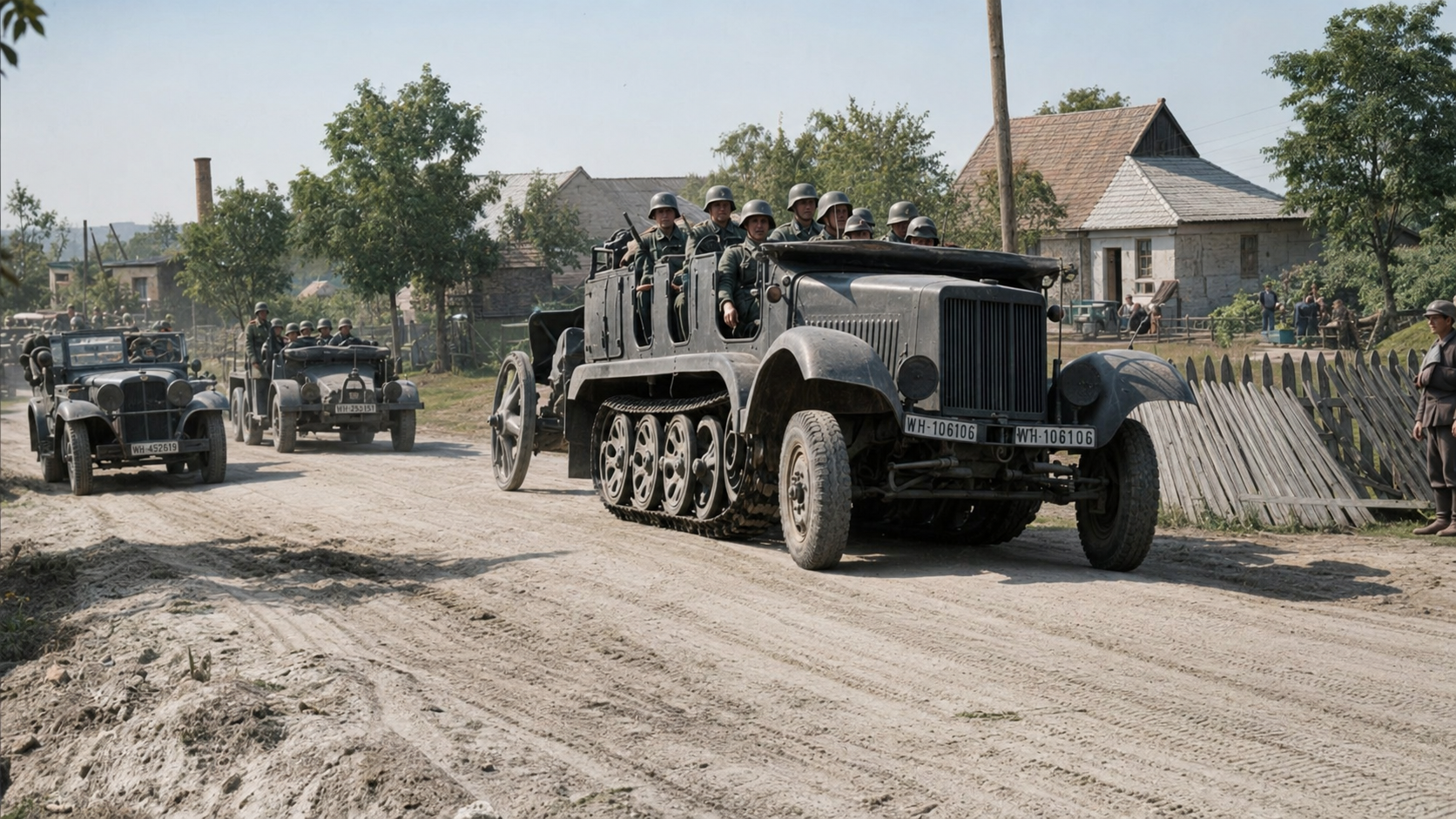
German troops ride a half-track in a motorised column passing through a Polish village.
A German motorised column passes through a Polish village, in a photograph issued by a German propaganda company. Colourised from original Bundesarchiv photograph. Bundesarchiv, Bild 101I-012-0012-05 / Falk / CC BY-SA 3.0 DE. Colourised derivative by LIVE WW2, released under the same licence.

Fighting went on across Poland today along a front running from the East Prussian border to the Carpathian foothills.

The German High Command says Polish resistance at the frontier has been broken, that its forces have crossed river lines at several points, and that its air force has hit military concentrations, railway junctions and airfields.

The Polish General Staff says its forces are pulling back to prepared positions as planned, that counter-attacks have been made, and that towns of no military significance have been bombed and civilians killed.

Neither account can be checked. There is no neutral correspondent with either army.

Warsaw has been bombed for a fourth day.

Correspondent

Japan says it will stay out of the European war and finish the war in China

The Far Eastern Courier

The Japanese Cabinet issued a statement in Tokyo this evening saying the Imperial Government will not become involved in the conflict that has broken out in Europe, and will devote its energies to resolving the China incident.

That's the whole statement. One sentence, and worth reading closely.

Read from here it is a statement about China. The war Japan is already fighting keeps first call on everything Japan has. That war is in its third year, it has cost more than anyone in Tokyo expected, and it hasn't produced the settlement that was promised.

Britain and France hold a great deal of territory in this region and the garrisons are small. This colony's defence has always rested less on its garrison than on the assumption that nobody would move against it while Britain was free to respond. Britain is not free to respond now. Tonight's statement says that won't be taken advantage of, for now.

Wire

Berlin denies a German submarine sank the Athenia

Allied Press Service

The German Foreign Office says no German submarine sank the Athenia.

Foreign correspondents were called in shortly after midday and told that no German submarine was anywhere near where the liner went down, and that German naval forces have orders to observe international rules at sea.

The accusation was described as propaganda aimed at American opinion.

The US chargé d'affaires was summoned to the Foreign Office and given the same assurance.

Britain has not responded. The First Lord of the Admiralty is expected to take questions in the Commons this afternoon.

Wire

Britain brings in contraband control and sets up Ministry of Economic Warfare

Allied Press Service

Britain has brought contraband control into force against trade with Germany and created a Ministry of Economic Warfare to run it.

A contraband schedule has been published. It covers arms and munitions and extends to fuel, metals, rubber and industrial raw materials consigned to enemy destinations. Anything on the schedule can be seized.

The Royal Navy enforces it. Merchant ships bound for European ports can be directed into contraband control stations to have cargo and papers examined.

The government says neutral shipping rights will be respected under international law.

How much this costs neutral trade depends on how the examinations are run and how long they take.

Correspondent

Nobody can tell you who holds the Danzig Post Office

The Stockholm Observer

Four days into the fighting in Danzig, this office can't tell you who holds the Polish Post Office, and you should be sceptical of anyone who says they can.

German authorities have called the city secure since Friday, and German broadcasts treat the elimination of Polish institutions there as a finished matter, without saying when, or how, or to whom.

Against that, neutral-press reports keep describing postal staff barricaded inside and still holding out. One ran this morning. They don't agree on how many men, or on what happened to anyone inside.

Both versions can't be true.

The reason is worth spelling out. Danzig has been under German control since Friday. What leaves it leaves with permission. There is no independent correspondent there, and every account reaching Stockholm has been through somebody's hands, and the hands belong to a party with an interest.

Wire

Air Ministry says leaflet aircraft are back, none lost to enemy action

Allied Press Service

RAF aircraft that flew over north-western Germany overnight dropping leaflets have returned, the Air Ministry says. None was lost to enemy action.

The leaflets were addressed to German civilians and set out the British case for the war. The Ministry says they were dropped over Hamburg, Bremen and industrial areas of the Ruhr.

It was the first RAF operation over German territory since the declaration.

Eyewitness

The warden found three windows on Chalcot Road and took no names

The London Sentinel
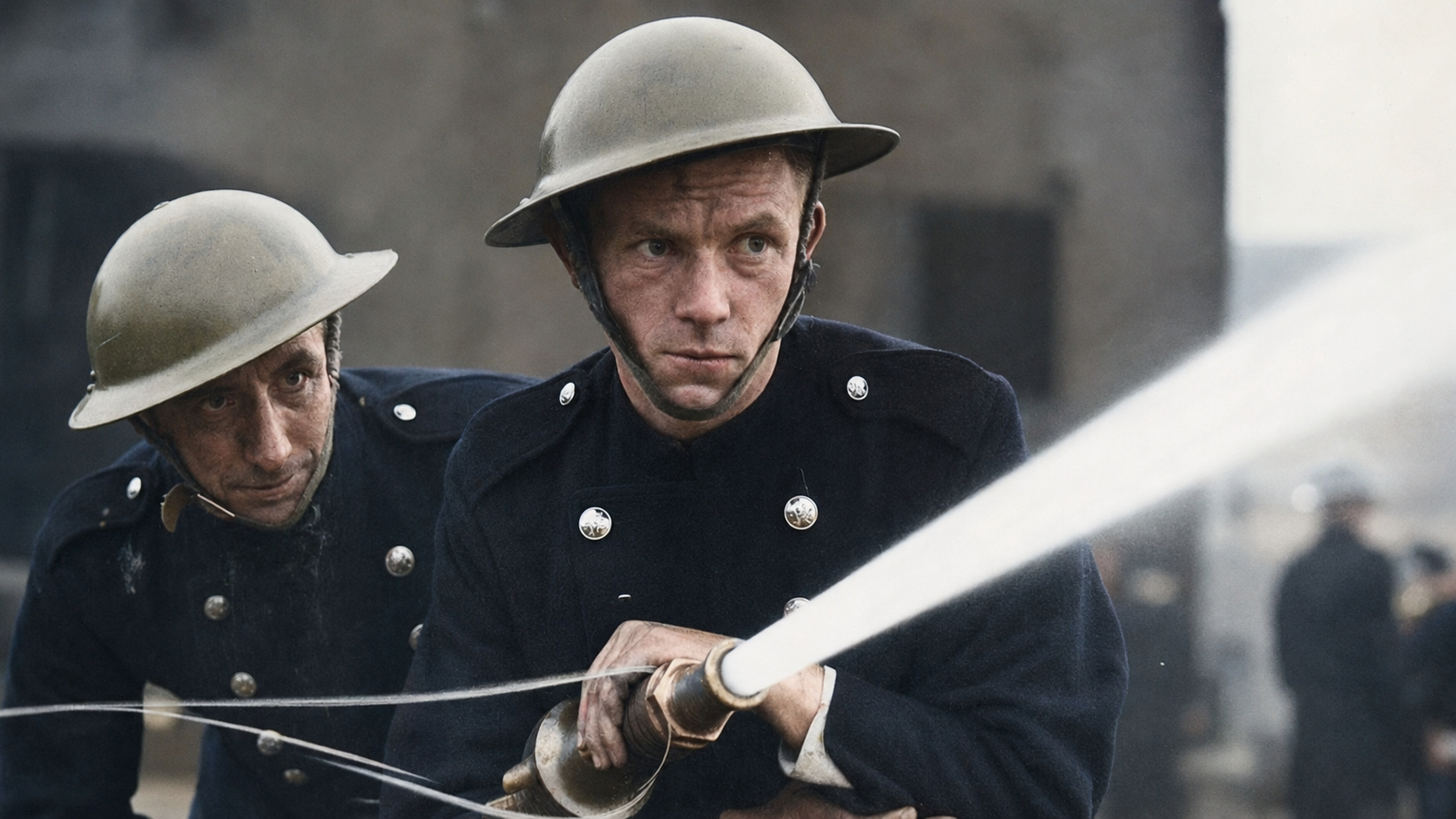
Two helmeted auxiliary firemen aim a pressurised hose during a London civil-defence exercise.
Auxiliary firemen work a hose during a civil-defence exercise, Greenwich. Colourised from original National Archives photograph. U.S. National Archives and Records Administration, 306-NT-901-19 (NAID 541892). No Copyright - United States.

The warden came down Chalcot Road just after 05:00 with his torch masked to a slit and found three windows he wasn't happy with.

He knocked at each. At the second a woman came to the door in a coat over her nightclothes: it was only the landing light, the curtain had slipped, she'd see to it. He wrote nothing down. He isn't required to yet.

This is the third night of the blackout and the first of the war. At dusk the curtains go up, the signs go dark, the buses run dimmed to a blue that makes strangers of everyone on board.

Wire

New Zealand backdates its declaration to match Britain's

Allied Press Service

The Governor-General has signed the formal instrument recording New Zealand's state of war with Germany.

The proclamation is dated to the hour Britain's own state of war began, not the hour it was signed in Wellington. New Zealand is therefore recorded as having entered the war at the same moment as the United Kingdom, with no gap.

The decision was announced on Sunday. Today's signing completes the formality.

Communiqué

Roosevelt: this nation will remain a neutral nation

The New York Register

The President broadcast to the American people from the White House at 22:00 Eastern time on Sunday. The text reached London and Paris by wire within the hour.

Official textThe President of the United States

Let no man or woman thoughtlessly or falsely talk of America sending its armies to European fields. At this moment there is being prepared a proclamation of American neutrality. This would have been done even if there had been no neutrality statute on the books, for this proclamation is in accordance with international law and in accordance with American policy. This will be followed by a proclamation required by the existing Neutrality Act.

This nation will remain a neutral nation, but I cannot ask that every American remain neutral in thought as well. Even a neutral has a right to take account of facts. Even a neutral cannot be asked to close his mind or close his conscience.

Correspondent

One torpedo has changed Britain's naval arithmetic

The Imperial Review

A passenger liner was hit in the Western Approaches at 20:59 on Sunday, and the Admiralty has been working through the night on what that means.

An unarmed vessel on no military errand was attacked 200 miles from land on the first day of the war. That is the fact, whatever the final death toll turns out to be.

The logic isn't complicated. Britain fights on tonnage. The merchant fleet brings in the food, the oil and the raw material without which neither navy nor population lasts a season. Germany's submarine force has never been thought big enough to threaten that supply alone.

Wire

Destroyers sent to Athenia's position overnight

Allied Press Service
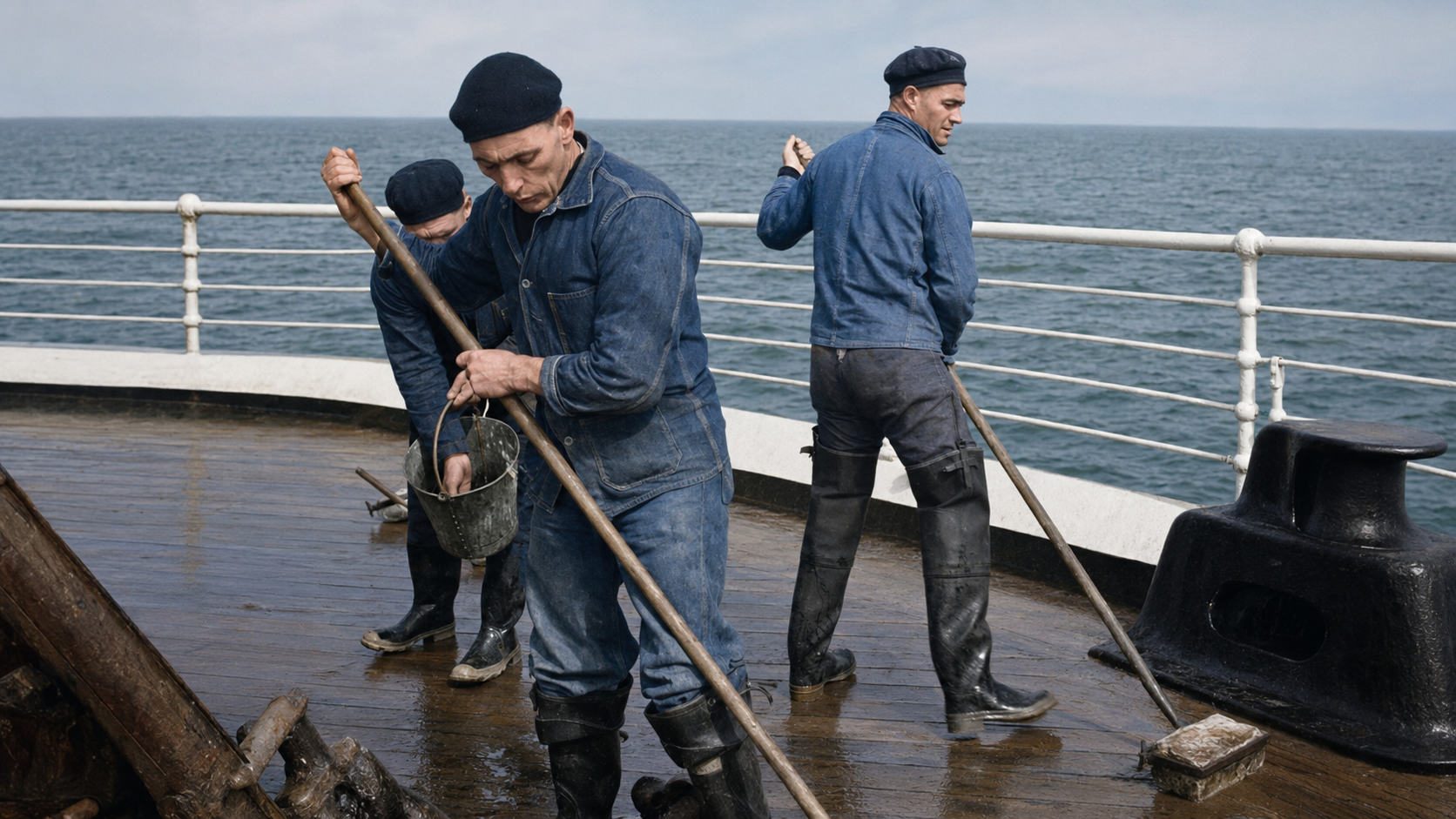
Three seamen in work clothes sand the wet deck of Athenia, with open sea beyond the rail.
Seamen sand the deck aboard Athenia at sea. Colourised from original Library of Congress photograph. Photograph: Paul Vanderbilt. Library of Congress Prints & Photographs, LC-DIG-fsa-8d37023. No known restrictions.

Four Royal Navy destroyers are heading at high speed to the position of the liner Athenia, reported torpedoed about 200 miles north-west of Ireland.

A signal reached the Admiralty late on Sunday evening saying the ship had been hit. Local commanders had already ordered destroyers to her. They are not expected to reach the position before morning.

The Athenia is a 13,500-ton Donaldson Line ship. She left Liverpool on Saturday afternoon for Montreal carrying 1,400 passengers.

There is no casualty figure and the cause of the explosion has not been established.

Irish authorities at Galway have been told to prepare to receive survivors.

The day in pictures

Three seamen in work clothes sand the wet deck of Athenia, with open sea beyond the rail.
Seamen sand the deck aboard Athenia at sea. Colourised from original Library of Congress photograph.Photograph: Paul Vanderbilt. Library of Congress Prints & Photographs, LC-DIG-fsa-8d37023. No known restrictions.
Two helmeted auxiliary firemen aim a pressurised hose during a London civil-defence exercise.
Auxiliary firemen work a hose during a civil-defence exercise, Greenwich. Colourised from original National Archives photograph.U.S. National Archives and Records Administration, 306-NT-901-19 (NAID 541892). No Copyright - United States.
German troops ride a half-track in a motorised column passing through a Polish village.
A German motorised column passes through a Polish village, in a photograph issued by a German propaganda company. Colourised from original Bundesarchiv photograph.Bundesarchiv, Bild 101I-012-0012-05 / Falk / CC BY-SA 3.0 DE. Colourised derivative by LIVE WW2, released under the same licence.
Two of the Royal Air Force's principal twin-engined bombers, drawn to a common scale.Graphic: LIVE WW2.
The two places London says were bombed today.Map: LIVE WW2.

Where things stood at the start of the day

Poland
The German offensive goes into a fourth day, Warsaw has been bombed, and the Polish account of where the line runs cannot be checked against the German one. The Westerplatte garrison has still not surrendered, and no Allied soldier is in Poland.
The Atlantic
The passenger liner Athenia, carrying more than 1,400 people, has been struck north-west of Ireland, and rescue vessels are converging on her position. The cause of the explosion has not been established, nobody has claimed responsibility, and the passengers have not been counted.
The air war
RAF aircraft crossed into Germany on the first night of the war carrying leaflets, not bombs, and the Air Ministry has not yet confirmed their return. London's first air-raid warning, sounded minutes after the declaration, proved false.
Britain and France
Britain has been at war since 11 a.m. British Summer Time, France since 5 p.m. Paris time. A War Cabinet has formed with Winston Churchill back at the Admiralty, conscription now covers the male population, and the evacuation of the cities is nearly finished.
The Empire
Australia, New Zealand and India are at war alongside Britain, and South Africa is divided and has not decided. Its parliament votes tomorrow, with the government's own survival resting on the result, and Canada's meets on 7 September.
Neutral nations
Ireland has confirmed it will not fight in this war and Italy remains outside the conflict despite her pact with Germany. The United States has not yet stated its position.
Background · prize rules and submarine warfare

What the law says about sinking a passenger ship

Both London and Berlin have invoked international law in the past twenty-four hours. They are talking about the same rules, and Churchill read them into the Commons record this afternoon.

Germany agreed in 1935 to abide by Part IV of the London Naval Treaty of 1930, in perpetuity, and was among the first powers to do so. That is the undertaking Churchill quoted to the House this afternoon.

The rule has two parts. Submarines are bound by the same law as surface warships. And except where a merchant ship persistently refuses to stop when summoned, or actively resists search, she may not be sunk without her passengers, crew and papers first being placed in a place of safety.

The qualification is the part that matters here. Ships' boats do not count as a place of safety unless sea conditions, proximity of land, or another vessel able to take people aboard make them so.