Skip to the day
LiveWW2The Second World War, in real time
Day 7
Thursday 7 September 1939

Berlin announces Westerplatte's surrender while Polish radio broadcasts that the position is defending itself, and Canada's parliament opens a war session without declaring war

From the LIVE WW2 feed

The day in dispatches

Filed through the day, as it happened
Newest first
Summary

What we know at the close of the seventh day

Allied Press Service

At the close of the seventh day, the position is this.

Berlin has announced that the Polish garrison at Westerplatte, which it puts at 120 men, surrendered at twenty past ten this morning, after holding the position since the first hour of the war. It has given no figure for the dead or the men taken. Polish radio was still broadcasting this afternoon that the position is defending itself.

Warsaw reports being bombed eight times during the day. The Polish command's figure for German aircraft lost is its own and is not confirmed.

Canada's Parliament opened a special war session and adjourned without declaring war. Canada is not a belligerent. Debate continues.

The Prime Minister has told the Commons that French forces are in contact with the enemy on the common frontier, that three or four British merchant ships have been sunk besides the Athenia, and that a convoy system is being established. He said at least two hits were secured on a German pocket battleship at Wilhelmshaven, and gave no figure for British aircraft lost.

Britain and France have granted Poland further financial assistance.

Close to one and a half million children and mothers have been moved out of British cities.

Germany has made listening to foreign broadcasts a criminal offence.
Editorial

The only figure for British aircraft lost over Wilhelmshaven was issued in Berlin

The London Sentinel

Three things needed saying today. One was said by the only government in a position to say it. The other two were not said at all.

The first is at Westerplatte. Berlin announced this afternoon that the garrison of 120 men surrendered at twenty past ten this morning, after holding the position since the first hour of the war. We have printed the announcement, because it is almost certainly true and it is the only account of that peninsula anyone outside it has. It does not say how many died or how many were taken.

While Berlin was announcing the surrender, Polish radio was broadcasting that Westerplatte is defending itself, as it has every day for a week. We have printed that too. We do not think Warsaw is lying. We think Warsaw does not know, and that a government learning the fate of its own garrison from its enemy is the sort of thing this war is going to keep producing.

Wire

Warsaw communiqué: eight raids in the day

Allied Press Service
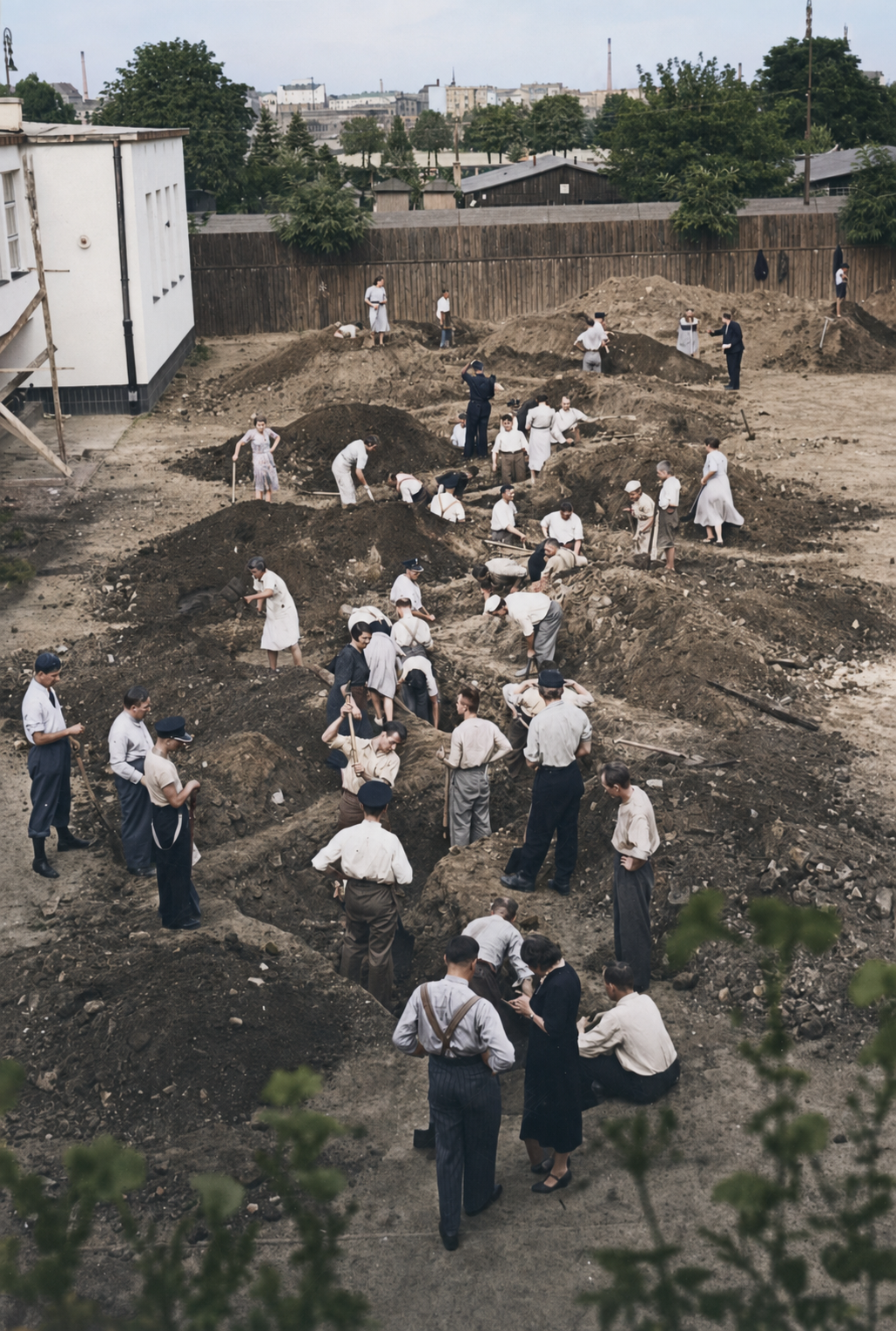
Officials and uniformed State Police digging anti-aircraft trenches in a school courtyard in Warsaw, photographed in August 1939.
Officials and State Police dig anti-aircraft trenches in a Warsaw school courtyard, photographed in August 1939. Colourised from original Narodowe Archiwum Cyfrowe photograph. Photograph: Narodowe Archiwum Cyfrowe, 3/1/0/7/3134/8, August 1939. Colourised.

A Polish communiqué says the capital was bombed eight times during the day.

It says leaflets were dropped during the eighth raid.

The communiqué also gives a figure for German aircraft brought down. That figure is the Polish command's own and this office has no means of checking it.

No casualty figure for the city has been issued.

Correspondent

Tokyo says Europe's war is not its business

The Far Eastern Courier

Japan has told the European powers that it will concentrate on China and does not intend to involve itself in their war. Talks with Britain over Tientsin have been suspended.

Two things are worth holding together here.

The first is that this is a statement of intention by a government, which is the cheapest thing a government produces. It costs nothing to say today and binds nobody tomorrow.

The second is that it is probably true, and true for reasons that have nothing to do with Europe. Japan has an unfinished war in China and an unresolved frontier with the Soviet Union where fighting has continued all summer without either side calling it a war. A country in that position does not want a third commitment, and Berlin's pact with Moscow last month gave Tokyo a good deal to think about regarding what German friendship is worth.

Correspondent

Canada is not at war, and today did not change that

The Southern Cross

Everything about this country is at war except its legal position.

The militia is on active service. The navy is on active service. The air force is on active service. Censorship is in force, shipping is controlled, trading with the enemy is prohibited and the machinery exists to intern enemy aliens. Parliament sat today to be told all of it.

And Canada is not a belligerent.

Yesterday this office wrote that refusing neutrality and declaring war are not the same act. Canada is the same distinction again, and it is taking longer, and the length is the point. Mr Mackenzie King undertook that Parliament would decide. Parliament is deciding, which takes days, because that is what deciding looks like when it is not a formality.

Wire

Canada's war session opens; no declaration

Allied Press Service
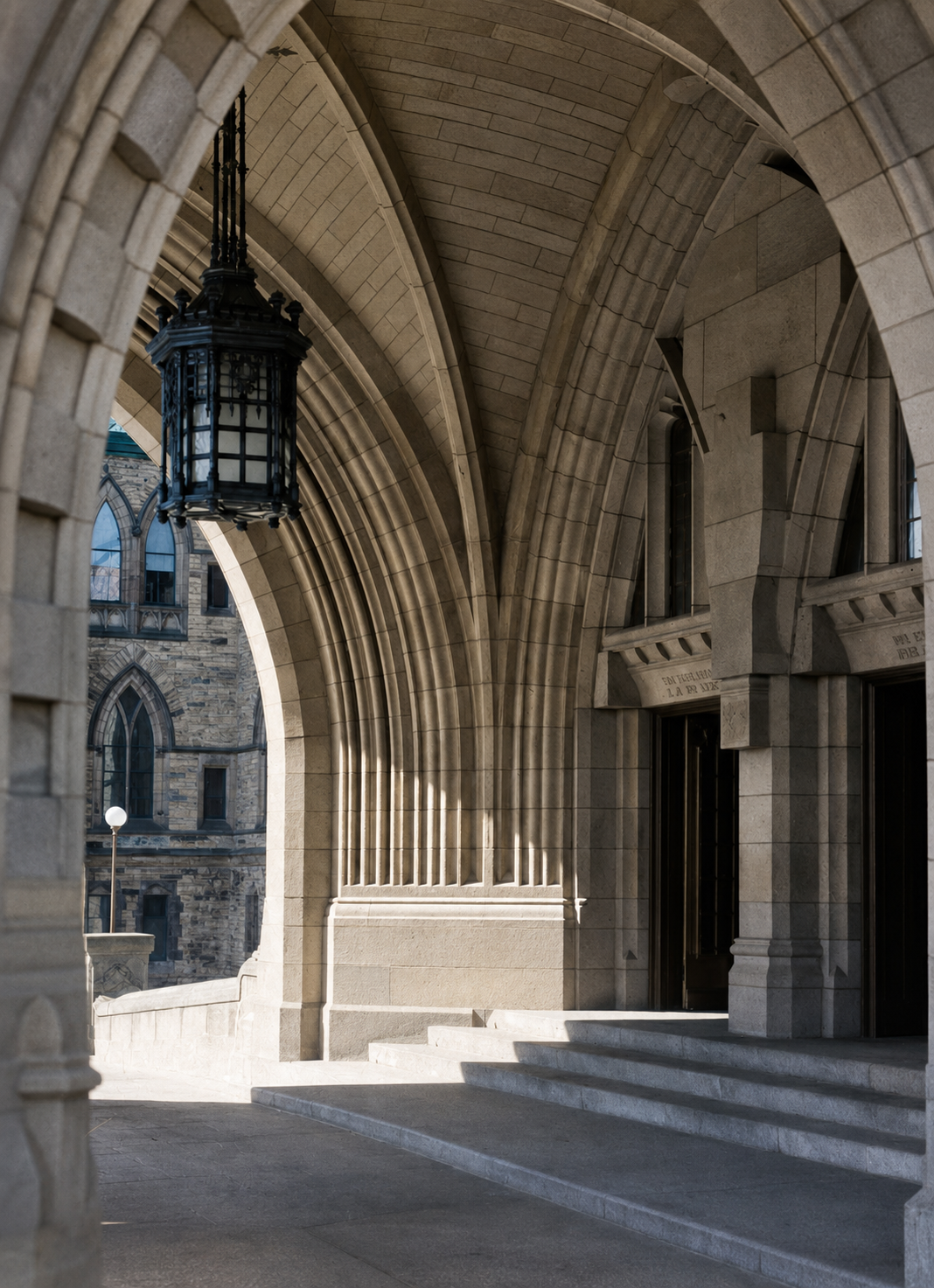
An empty stone arcade beneath the Peace Tower of the Parliament Buildings in Ottawa, photographed in 1934, with sunlight falling across the steps.
The arcade beneath the Peace Tower, Parliament Buildings, Ottawa, photographed in 1934. Colourised from original Library and Archives Canada photograph. Photograph: Clifford M. Johnston, 1934. Library and Archives Canada, PA-056763. Copyright expired, restrictions nil. Colourised.

Canada's Parliament opened a special session today and adjourned without declaring war.

The Governor-General, Lord Tweedsmuir, told the two Houses that Parliament had been summoned so that the government might seek authority for the defence of Canada and for co-operation in the effort to resist further aggression.

Emergency measures already in force were laid before the House. They cover censorship of communications and post, control of shipping, trading with the enemy, price control and provision for the internment of enemy aliens. The militia, the naval service and the air force are on active service.

Canada is not at war with Germany. Debate continues.

Wire

Switzerland orders visas as refugees reach the frontier

Allied Press Service

Switzerland has introduced a visa requirement for foreigners entering the country.

The measure follows the arrival of people at the Swiss frontier from countries now at war. Numbers have not been given.

Switzerland has declared its neutrality and has mobilised for the defence of its borders.

Correspondent

The clearest statement about the French army today was made in London

The Paris Dispatch

The Prime Minister of Great Britain told the House of Commons this afternoon that French forces are now in contact with the enemy on the common frontier.

That is the plainest thing said publicly about the French army since this war began, and it was said two hundred miles away by a foreign government.

The communiqué issued here says less. It has said less for three days. This correspondent has written twice that the accounts grow more specific the further you get from the frontier, and today the pattern has produced its clearest example: the most definite statement comes from another capital altogether.

Wire

Germany makes listening to foreign broadcasts a crime

Allied Press Service
The page of the Reichsgesetzblatt carrying the decree making it a criminal offence in Germany to listen to foreign broadcasts. Reichsgesetzblatt, 1939. Reich Ministry of the Interior. Scan: Deutsches Rundfunkarchiv. Public domain as a German official work.

Listening to foreign radio broadcasts has been made a criminal offence in Germany.

The decree covers reception of foreign stations and the passing on of what is heard. Penalties are severe.

The measure applies to the whole population and to broadcasts from any foreign country.

Wire

Smuts sets the limits of South Africa's war

Allied Press Service

General Smuts has set out what the Union's entry into the war will and will not mean.

South Africa will defend its own territory and the sea route round the Cape, and will assist in trade, shipping and finance. He said the Union's first duty is its own defence, and that his government could not at this stage encourage citizens wishing to serve overseas.

The Union declared a state of war with Germany yesterday.

General Smuts took office on Tuesday, after his predecessor's motion for neutrality was defeated in the House of Assembly.

Wire

Chamberlain: more than ten million leaflets dropped over Germany

Allied Press Service

The Prime Minister has told the Commons that more than ten million leaflets have been distributed over German territory on three successive nights.

Aircraft returning from the first of these flights were reported last week as having encountered no enemy action.

The aircraft have flown at night. He said the leaflets were distributed over northern and western Germany, including the Ruhr.

Wire

Chamberlain: about 1,475,000 moved out of the cities

Allied Press Service

About 1,475,000 children and mothers have been moved out of British cities under the government evacuation scheme, the Prime Minister has told the Commons.

The movement began on 1 September and has continued since. It covers London and other places considered likely to be attacked.

Correspondent

Chamberlain repeated the damage claim and left the bomber losses unanswered

The London Sentinel

On Monday the Ministry of Information said British aircraft had struck German warships at Wilhelmshaven and Brunsbüttel. On Tuesday Berlin said the attack achieved nothing and that five British bombers were brought down. This afternoon the Prime Minister told the House that at least two hits had been secured on a pocket battleship.

He did not raise the bombers.

Three days is not long in a war. It is long for a figure the Air Ministry has had since the aircraft either returned or did not. Nobody is waiting on evidence here. The evidence is a count of aeroplanes on an aerodrome in England, and it was complete by Monday evening.

Situation map

The approaches to Warsaw, and a position Berlin says has fallen

Poland at four o'clock on the seventh day. Two accounts of Westerplatte were current this afternoon and they are not compatible. Map: LIVE WW2.
Correspondent

Berlin says Westerplatte has surrendered; Warsaw has not confirmed it

The Stockholm Observer

Berlin announced this afternoon that the garrison at Westerplatte surrendered at twenty past ten this morning, and put its strength at 120 men. Polish radio spent this afternoon broadcasting that Westerplatte is defending itself, as it has every day since the first.

Both were said today. They cannot both be true.

This office is not going to pretend the two are evenly matched. A surrender is an ordinary thing to announce, the position had been under attack from a battleship, artillery and aircraft since the first morning of the war, and Germany has men on the peninsula and Warsaw has not. The German account is very probably right.

Eyewitness

The evacuees were billeted in the village hall, and two were left at six

The London Sentinel

They came up from the station in a line, two and three abreast, and the woman at the front counted them twice before she let them cross the road.

Labels on the coats. Gas mask boxes on string. A good many of them carrying a paper bag from the school, and one boy carrying nothing at all and holding his sister's hand instead.

The billeting was done in the village hall. Householders came in and were given names, and there was a long moment, several times over, when a child stood by a table while two adults decided something about him.

Wire

Chamberlain: at least two hits at Wilhelmshaven; British losses still not given

Allied Press Service

The Prime Minister has told the Commons that at least two hits were secured on a German pocket battleship in Monday's air attack.

He gave no figure for British aircraft lost.

Berlin said on Tuesday that five British bombers were brought down. No British figure has been issued at any point since the raid.

The claim of damage has now been made three times by three departments. The question of losses has been left unanswered since Monday.

Wire

Chamberlain: three or four more merchant ships lost, convoys being established

Allied Press Service

The Prime Minister has told the Commons that, apart from the Athenia, three or four British merchant ships have been sunk.

He said anti-submarine forces are active and that a convoy system is being established at the earliest possible moment, to be applied with the utmost speed and vigour.

He did not name the ships, give their positions, or say how many lives had been lost.

Nor did he give any figure for enemy submarines.

Wire

Berlin says Westerplatte has surrendered

Allied Press Service

Germany has announced that the Polish garrison at Westerplatte surrendered this morning at twenty minutes past ten.

The announcement was made officially here this afternoon. The German Supreme Command puts the garrison at 120 men. The transit depot in Danzig harbour had been under attack since the morning of 1 September.

No figure has been given for the dead, or for the number taken. The condition of the men is not known.

Polish radio was still broadcasting this afternoon that Westerplatte is defending itself. That broadcast has been repeated every day since the war began.

Germany has announced the fall of a position it alone can see.

Correspondent

The loan to Poland cannot reach it; every route in is closed

The Atlantic Ledger

Britain and France have lent Poland money. The question a reader is entitled to ask is what Poland can buy with it this week.

Money buys equipment. Equipment has to arrive. Poland's Baltic ports are under attack or blockaded, its southern neighbours have declared neutrality and will not pass munitions, and Romania resolved yesterday on strict observance of the rules, which is precisely the phrase that closes a frontier to a belligerent's cargo.

Which leaves a route through the Soviet Union, and nobody in London is proposing that.

None of this makes the agreement empty. Credit outlives a campaign. A government that expects to exist in a year borrows in the first week, and lenders who expect it to exist lend.

Wire

Britain and France grant Poland a war loan

Allied Press Service

Britain and France have agreed further financial assistance to Poland. Britain is to advance £5 million and France 600 million francs.

The agreement is dated today and takes effect at once.

Poland's ports are closed to Allied shipping and its land routes to the west run through countries that have declared themselves neutral.

Correspondent

Berlin counts Polish prisoners; Warsaw counts German aircraft

The Stockholm Observer

A week into this war, the only people who know where the German army is are the two armies, and neither will tell anybody.

Berlin issues figures for prisoners and guns. Warsaw issues figures for German aircraft brought down. Both are counting the other side's losses, which is the one count nobody can check and the one every army has an interest in.

What can be established from here is narrower and duller. German forces are reported advancing on Warsaw from more than one direction, and the Polish government has asked civilians to dig. Neither of those requires taking anyone's word for a number.

Wire

Berlin claims further advance in Poland

Allied Press Service

The German High Command says its forces have advanced further into Poland and taken large numbers of prisoners and guns.

It gives figures for both. No independent account supports them and this office has none.

The announcement follows yesterday's claim that Kraków had been taken.

Wire

Warsaw bombed again during the night

Allied Press Service

German aircraft attacked the Polish capital repeatedly during the night and into the early morning.

The raids came in separate waves. No count has been issued and no casualty figure has been given.

The city was preparing its defences yesterday, with citizens called out to dig field works beyond the built-up area.

Where the German ground forces stand is not established. They were reported yesterday to be advancing on the capital from more than one direction.

The day in pictures

Officials and uniformed State Police digging anti-aircraft trenches in a school courtyard in Warsaw, photographed in August 1939.
Officials and State Police dig anti-aircraft trenches in a Warsaw school courtyard, photographed in August 1939. Colourised from original Narodowe Archiwum Cyfrowe photograph.Photograph: Narodowe Archiwum Cyfrowe, 3/1/0/7/3134/8, August 1939. Colourised.
Poland at four o'clock on the seventh day. Two accounts of Westerplatte were current this afternoon and they are not compatible.Map: LIVE WW2.
The page of the Reichsgesetzblatt carrying the decree making it a criminal offence in Germany to listen to foreign broadcasts.Reichsgesetzblatt, 1939. Reich Ministry of the Interior. Scan: Deutsches Rundfunkarchiv. Public domain as a German official work.
An empty stone arcade beneath the Peace Tower of the Parliament Buildings in Ottawa, photographed in 1934, with sunlight falling across the steps.
The arcade beneath the Peace Tower, Parliament Buildings, Ottawa, photographed in 1934. Colourised from original Library and Archives Canada photograph.Photograph: Clifford M. Johnston, 1934. Library and Archives Canada, PA-056763. Copyright expired, restrictions nil. Colourised.

Where things stood at the start of the day

Poland
Berlin announced yesterday that its forces hold Kraków, and no independent account of the city has reached this desk. Warsaw is preparing to be fought over, with civilians and government departments moving east and German columns reported approaching from more than one direction.
The Atlantic
Churchill has given the Commons the first count for the Athenia: 1,418 aboard, about 125 unaccounted for, and more than 300 holding United States passports. He says sworn statements establish the ship was attacked without warning by a submarine, and he did not say whose.
Britain at home
Air-raid sirens sounded across London at 06:42 yesterday and anti-aircraft guns were heard firing, with no damage reported. The Home Secretary says the warning reached street wardens late and their whistles were taken for the all-clear, sending people back up from the shelters.
Western Front
The French communiqué reports local advances and names no sector, formation or objective. Accounts reaching correspondents in Paris place French troops beyond the German frontier, but they carry nobody's name and the Ministry of War will not comment.
The Empire
South Africa is at war, settled by a proclamation in a Government Gazette Extraordinary after the Union voted down neutrality 80 to 67, Hertzog resigned and Smuts took office. It says nothing about what forces will be raised, and Canada's parliament meets today.
Neutrals
Roosevelt has signed the arms embargo, which applies to both sides equally and names neither South Africa nor Canada. Romania has resolved on strict neutrality, and Iraq has broken relations with Germany without declaring war.
Background

What a Dominion has to do to be at war

Canada's Parliament sat today, heard that the country's forces are already on active service, and went home without declaring war. That is not a contradiction, and the reason lies in a statute passed eight years ago.

Before 1931. Before 1931 the Dominions were at war when Britain was at war. The King declared, and the declaration carried. Nobody in Ottawa or Canberra or Pretoria was asked.

After 1931. The Statute of Westminster ended that. Each Dominion now has its own Crown and its own capacity to declare, which means each has had to find its own route to the same destination, and this week they have taken six different ones.