Skip to the day
LiveWW2The Second World War, in real time
Day 8
Friday 8 September 1939

Berlin says its armoured troops have entered Warsaw and the Polish Embassy in London calls it completely false, while Roosevelt proclaims a limited national emergency and Canada's Commons debates without declaring war

From the LIVE WW2 feed

The day in dispatches

Filed through the day, as it happened
Newest first
Summary

What we know at the close of the eighth day

Allied Press Service
Five questions a government had been asked and had not answered by the end of the day. The evacuation figure is Thursday's, given once and not revised since. Graphic: LIVE WW2.

At the close of the eighth day, the position is this.

Berlin says its armoured troops entered Warsaw this afternoon. The Polish Embassy in London calls that completely false and says the city is under air attack as it speaks. No third account exists. Warsaw radio, silent through Thursday, was heard again this morning calling on the capital to fortify itself. Nothing has been heard from it since.

Berlin says it holds 25,000 Polish prisoners. Warsaw says about 1,500.

The French War Ministry reports further local advances in the Saar. Paris papers put the northern flank seven or eight miles into Germany; the communiqué gives no distance.

A Dutch minesweeper and a German steamer have been lost to what survivors believe were mines, 29 dead in one case and seven in the other. No government has said whose mines.

Still not given: any Polish word on Westerplatte, any British figure for aircraft lost at Wilhelmshaven, any new total for merchant ships lost.

President Roosevelt has proclaimed a limited national emergency and applied the neutrality law to South Africa. Canada's Commons is still debating the Address.
Editorial

Berlin's word is not evidence that Warsaw has fallen

The Imperial Review

The German High Command said this afternoon that its armoured troops had entered Warsaw at 5.15, Berlin time. The Polish Embassy in London called that completely false this evening. Between those two statements there is nothing at all: no third account, no observer, no photograph, no named commander.

This paper's position is that the German announcement should not be printed anywhere as a fact, and that includes being printed as a fact with a qualifier attached to it. A claim reported often enough with the word claim in front of it still ends the week as the thing everybody remembers.

Wire

Opposition leader tells the Commons this war is Canada's war

The Southern Cross

Robert Manion, the leader of the Opposition, told the House of Commons today that to him this war is Canada's war, and set out the causes for which he said Canada is going to war alongside Britain and France.

Prime Minister Mackenzie King has told the House that Canada will act with Britain and France if the House supports the government's policy, and that a government unable to carry the House on it should give way.

No vote has been taken. The debate on the Address continues.

Wire

Japanese Canadians pledge loyalty and service to Ottawa

The Southern Cross

The Japanese Canadian Citizens League has sent Prime Minister Mackenzie King a telegram pledging the loyalty and service of its members.

The telegram was sent while Parliament was still debating whether Canada goes to war.

The New Canadian, published here today, carries an article on the national emergency and on the responsibilities of Japanese Canadians in it.

Correspondent

Berlin says Warsaw has been entered; the Polish Embassy calls it false

The London Sentinel

Berlin says its armoured troops entered Warsaw this afternoon. The Polish Embassy here says that is completely false and adds that the city is being bombed as it speaks.

Both statements were made about the same place within a few hours of each other. Only one of them can be true about the ground. Both could be true about the air, because a city can be bombed whether or not soldiers have reached its streets.

The Embassy's second point is the one that has had least attention this evening and is the more checkable of the two. It is a claim about an air raid in progress, made by people who say they have a line open to the city.

Wire

Polish Embassy says the Warsaw report is completely false

Allied Press Service

The Polish Embassy in London says the German announcement that troops have entered Warsaw is completely false.

The Embassy says it is in direct communication with Warsaw and that the capital is at this moment undergoing another German air raid.

The German statement was issued this afternoon and has not been withdrawn.

The Embassy's statement was issued this evening, some hours after Berlin's.

Wire

Washington applies its neutrality law to South Africa

The New York Register

President Roosevelt has issued two further proclamations applying American neutrality law to the state of war between Germany and the Union of South Africa.

The first extends the neutrality provisions issued on 5 September. The second extends the statutory embargo on the export of arms, ammunition and implements of war.

The embargo applies to South Africa on the same terms as to the other belligerents.

South Africa's parliament voted for war four days ago and General Smuts set out the limits of that commitment yesterday.

Correspondent

Warsaw radio is still broadcasting; Berlin says the city has been entered

The Stockholm Observer

The most useful instrument in this war so far, from where this office sits, has been a radio transmitter in Warsaw.

It was silent through Thursday. Nobody in Warsaw explained why. It came back this morning and monitors in Budapest took down what it said: that the withdrawal is strategic, that the city is to be fortified, that Poland will not capitulate, and that the Germans hold about 1,500 Polish prisoners rather than the 25,000 Berlin has given.

That is a great deal of information from a country whose front nobody is allowed to visit. It is also, every word of it, the Polish government talking about itself.

Wire

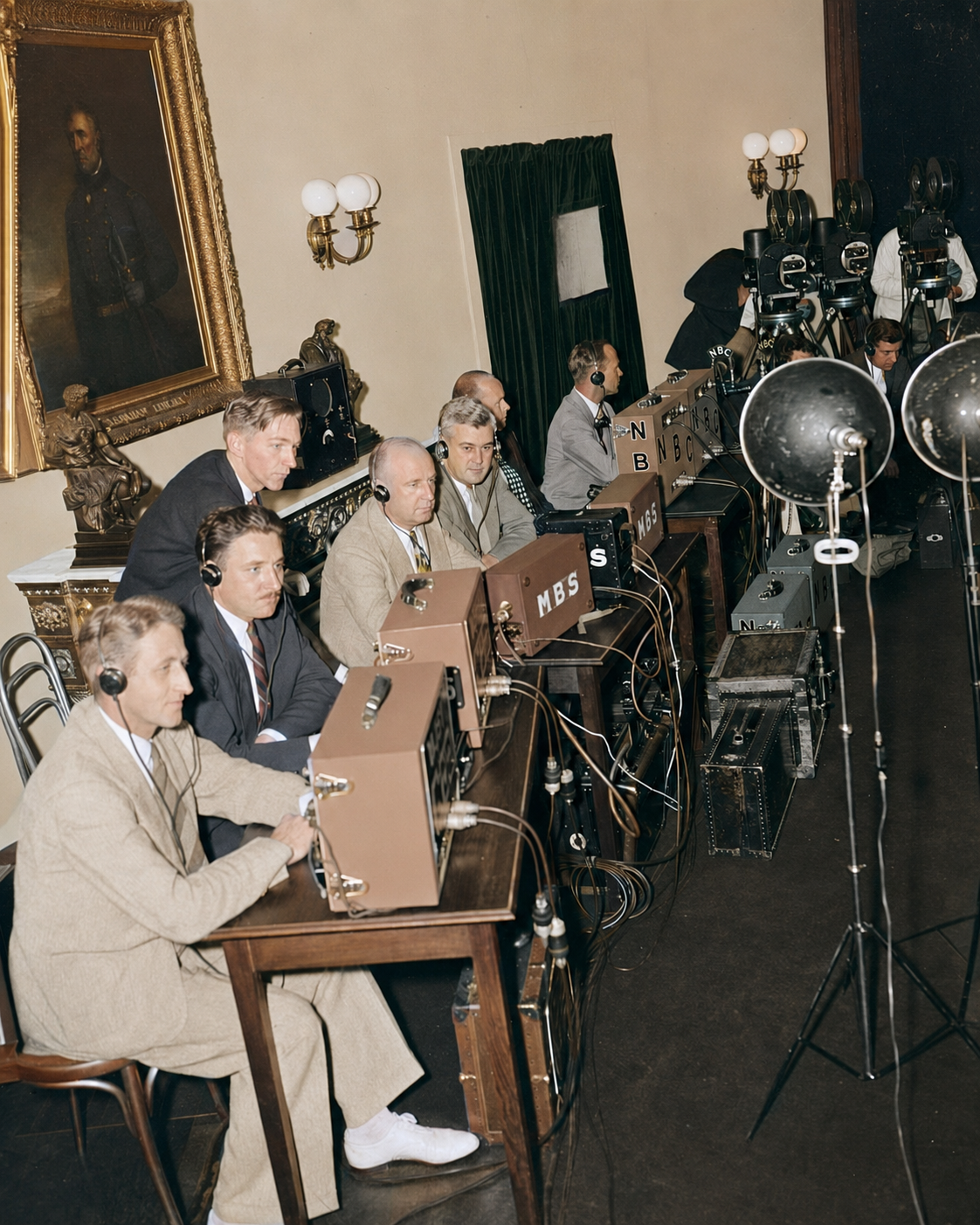
Roosevelt proclaims a limited national emergency

The New York Register
Radio operators wearing headphones sit among network equipment, microphones and cables inside the White House, photographed in 1938 or 1939.
Radio press equipment set up inside the White House, Washington, photographed in 1938 or 1939. Colourised from original Library of Congress photograph. Photograph: Harris & Ewing. Library of Congress Prints & Photographs, LC-DIG-hec-27209, 1938 or 1939. No known restrictions. Colourised.

President Roosevelt has proclaimed a national emergency, limited to the enforcement of American neutrality and the strengthening of national defence within peace-time authorisations.

The proclamation states that only a limited number of emergency powers are required.

Measures announced with it include increased Army recruitment and the recall of first-line reserves, an increase in Navy personnel, changes affecting the National Guard and the Marine Corps, enlarged investigative staffing against sabotage, and $500,000 for the State Department to help Americans return from the war zone.

Congress is not in session.

Wire

Berlin says its armoured troops have entered Warsaw

Allied Press Service
The two statements about Warsaw, and the three hours and twenty minutes between them. Nothing independent has been established in that gap. Graphic: LIVE WW2.

The German Supreme High Command says German armoured troops entered Warsaw at 5.15 this afternoon, Berlin time.

The announcement also places German forces at Nadarzyn, south-west of the city.

No confirmation from Warsaw has reached this office. Warsaw radio was broadcasting this morning and said the capital was being fortified for its defence.

The claim has not been repeated with the name of any unit or any account of resistance met.

Wire

Roosevelt says there is no food shortage in prospect

The New York Register

President Roosevelt told his press conference today that the United States has ample food supplies and that he sees no shortage in prospect.

He said fears of a scarcity of sugar and flour are not supported by the facts available to the government.

Prices for both have moved since the outbreak of the war in Europe.

Correspondent

Two ships have gone down in the Sound and no one says whose mines

The Atlantic Ledger

A Dutch minesweeper in Dutch coastal waters. A German steamer south of the Øresund. Both reported today, both attributed by survivors to mines, and in neither case has any government said whose.

That is not evasion on anyone's part. A drifting mine carries no marking that a survivor in the water can read, and the two navies laying them are not publishing charts. The cause in both reports is what the men who were on board believe happened.

For shipping the practical effect is the same whoever laid them. A mine that cannot be attributed sinks a ship exactly as a mine that can, and it does so in waters that both of these vessels had every right to be in.

Wire

German steamer sunk south of the Øresund, seven lost

Allied Press Service

The German steamer Helfrid Bismark has been sunk south of the Øresund. Survivors believe a mine was responsible.

Seven of the crew are reported killed and seven brought ashore.

Shipping authorities here have said they are concerned about drifting mines in the approaches. No government has stated whose mines are in these waters.

Correspondent

Paris papers say seven or eight miles; the communiqué does not

The Paris Dispatch

The official French statement this morning says local advances. Several Paris papers this afternoon say the northern flank has gone seven or eight miles into Germany.

The distance is not in Communiqué No. 9. It is not in any French official statement issued today. Where it has come from has not been said by the papers carrying it, and the French High Command has not confirmed it.

That does not make it wrong. Correspondents at the front have sources that a ministry statement does not use, and communiqués are written to give away as little as possible about where a line actually sits. A ministry that has advanced seven miles has good reasons for saying local advances.

Wire

Dutch minesweeper lost, 29 reported dead

Allied Press Service

A Dutch minesweeper has been disabled by an explosion in coastal waters. Survivors believe the explosion was caused by a mine.

The report gives 29 of the crew killed.

The figure is what has been reported today and may change. The cause has not been officially established.

The Netherlands is neutral.

Wire

French communiqué reports local advances in the Saar

Allied Press Service

The French War Ministry says its troops have made new local advances in the Saar sector and have strengthened their forward positions.

The statement is Communiqué No. 9. It gives no distances, no place names and no casualty figures.

It is the ninth such communiqué since the French declaration of war and the third to report movement on this sector.

Wire

Earle Page to give up the Country Party leadership

The Southern Cross

Sir Earle Page announced this evening that he will submit his resignation as leader of the Country Party.

He said his continuing in the post should not stand in the way of efforts to form a broader government for the war.

The parties disagree about what form such a government should take, and the efforts continue.

Wire

Berlin places its columns at Nadarzyn and beyond Pułtusk

Allied Press Service

The German High Command says its columns have passed Pułtusk, Mszczonów and Rawa Mazowiecka, and that armoured forces are at Nadarzyn, south-west of Warsaw.

Nadarzyn is the closest point to the Polish capital named in any German statement so far.

Warsaw radio said this morning that the Polish withdrawal is strategic and that the capital is being fortified. It gave no positions.

Every one of those place names comes from the German High Command alone.

Correspondent

Berlin says 25,000 Polish prisoners; Warsaw says 1,500

The Stockholm Observer

Berlin says 25,000 Polish prisoners. Warsaw says about 1,500. The gap is not a discrepancy of the kind that gets narrowed by more reporting. It is nearly seventeen to one.

Both are prisoner counts, which is the category of number that an army has the strongest reason to publish and the weakest reason to publish accurately. Prisoners are the cheapest evidence of success available. They do not require ground to be held.

A German figure of 25,000 would suggest formations surrendering whole. A Polish figure of 1,500 would suggest a week of retreat with the army mostly intact. Those are not two versions of the same week. They are two different wars.

Wire

Warsaw radio says only 1,500 Poles have been taken prisoner

Allied Press Service

Warsaw radio said this morning that German forces have taken about 1,500 Polish soldiers prisoner in the first week of the war.

The German High Command has given a figure of 25,000.

The same broadcast said the Polish air fleet remains intact. No figure was given for aircraft.

Neither claim can be tested. Both are each side's account of what it has taken from the other.

Wire

Warsaw radio is heard again and calls on the city to dig

Allied Press Service

Warsaw radio was broadcasting again this morning after being silent through Thursday. Listeners here picked up the station in the early hours. Why it was off the air has not been explained by anyone in Warsaw.

The broadcast said the Polish withdrawal has been strategic, that the Polish Army will take the offensive, and that Poland will not capitulate. It called on the citizens of Warsaw to fortify the city and to continue its defence.

That is the Polish government's own account of its army's condition. Nothing in it can be checked from here.

The station gave no positions and no dates. Its return is at present the only direct signal out of the Polish capital available in this city.

The day in pictures

The two statements about Warsaw, and the three hours and twenty minutes between them. Nothing independent has been established in that gap.Graphic: LIVE WW2.
Radio operators wearing headphones sit among network equipment, microphones and cables inside the White House, photographed in 1938 or 1939.
Radio press equipment set up inside the White House, Washington, photographed in 1938 or 1939. Colourised from original Library of Congress photograph.Photograph: Harris & Ewing. Library of Congress Prints & Photographs, LC-DIG-hec-27209, 1938 or 1939. No known restrictions. Colourised.
Five questions a government had been asked and had not answered by the end of the day. The evacuation figure is Thursday's, given once and not revised since.Graphic: LIVE WW2.

Where things stood at the start of the day

Poland
Berlin says Westerplatte surrendered at twenty past ten yesterday and puts the garrison at 120 men, giving no figure for the dead or taken. Polish radio was still broadcasting that the position is defending itself, and Warsaw reports eight air raids.
The Atlantic
Chamberlain has told the Commons that three or four British merchant ships have been sunk besides the Athenia, naming none and giving no positions. A convoy system is being established, and the government has still given no figure for British aircraft lost.
Britain at home
About 1,475,000 children and mothers have been moved out of British cities since 1 September, the Prime Minister says. More than ten million leaflets have been dropped over northern and western Germany on three successive nights, and the aircraft reported no enemy action.
Western Front
The plainest public statement about the French army came from London: Chamberlain told the Commons that French forces are in contact with the enemy on the common frontier. The Paris communiqué has said less than that for three days and still names no sector.
The Empire
Canada's Parliament opened its special war session and adjourned without declaring war. Smuts has set the limits of South Africa's war: defence of the Union and the Cape route, and help with trade, shipping and finance.
Neutrals
Japan has told the European powers it will concentrate on China and stay out of their war, and its talks with Britain over Tientsin are suspended. Switzerland has imposed a visa requirement on foreigners as people reach its frontier from countries at war.