Skip to the day
LiveWW2The Second World War, in real time
Day 9
Saturday 9 September 1939

A Swedish legation tells Stockholm that Warsaw is not occupied, against Berlin's claim of entry, while Britain orders its departments to plan for a war of at least three years and Göring tells armaments workers that 1918 will never be repeated

From the LIVE WW2 feed

The day in dispatches

Filed through the day, as it happened
Newest first
Summary

What we know at the close of the ninth day

Allied Press Service

Warsaw is still contested. Berlin says its troops entered the capital yesterday afternoon, Poland says that is false, and the Swedish Legation in Warsaw has told Stockholm the city is not occupied.

The French High Command says the Warndt Forest, on German territory west of Forbach, is almost entirely in French hands.

Canada has not declared war. The Commons debated overnight, resumed at three this afternoon, and has not divided.

TASS says Soviet reserve classes are being called up, citing the widening German-Polish war.

Britain's Government has told departments to plan for a war lasting at least three years.

Thirty of the 97 British merchant ships held at Gibraltar have sailed under destroyer escort. Sixty-seven remain.

Not said today: any Polish statement on Westerplatte. Any British figure for aircraft lost at Wilhelmshaven. Any new total for British merchant shipping losses. Any revision of Thursday's evacuation figure.
Editorial

Who do you believe, and how long can this last

The Imperial Review

Yesterday this paper argued that Berlin's claim to have entered Warsaw should not be printed as a fact. It was a claim by one army, denied within hours by the other, and nothing stood between them. We said so knowing that today might make us look foolish.

Today has not made us look foolish, and we take no particular satisfaction in that. The Swedish Legation, which has people inside the city, has told Stockholm that Warsaw is not occupied. Had the Legation said the opposite we would have printed that instead, and said we had been wrong to doubt.

Correspondent

Government orders departments to plan for a war of at least three years

The London Sentinel

The Government has told its departments to plan on the basis that this war may last at least three years.

A statement to that effect is being issued tonight. Departmental programmes for munitions, aircraft, manpower and industrial capacity are to be framed against that horizon, and the country's resources mobilised accordingly.

It is a planning assumption and not a forecast. Nobody in Whitehall is predicting the war will last three years. What has happened is that the Government has decided it cannot organise production on the assumption of a short one, which is a different statement and a heavier one.

Correspondent

Göring tells armaments workers 1918 will never be repeated

The Stockholm Observer

Hermann Göring told armaments workers today that Germany is armed and supplied well enough to withstand a long war and an Allied blockade.

“1918 will never be repeated,” he said.

Most of the speech was directed at Britain. Göring also said Germany wants nothing from France. “We want nothing from the French” is the phrasing that went out on the international transmission.

The claims about German stocks are claims and cannot be checked from here. What Germany actually holds in reserve is not published and would not be accurate if it were.

The speech is more useful as evidence of what Berlin is worried about. A blockade has not yet had time to be felt. Göring is addressing a factory about the ending of the last war, which suggests the comparison is being made without his help.

Correspondent

Canadian Commons resumes; King says adoption of the Address opens the way

The Southern Cross
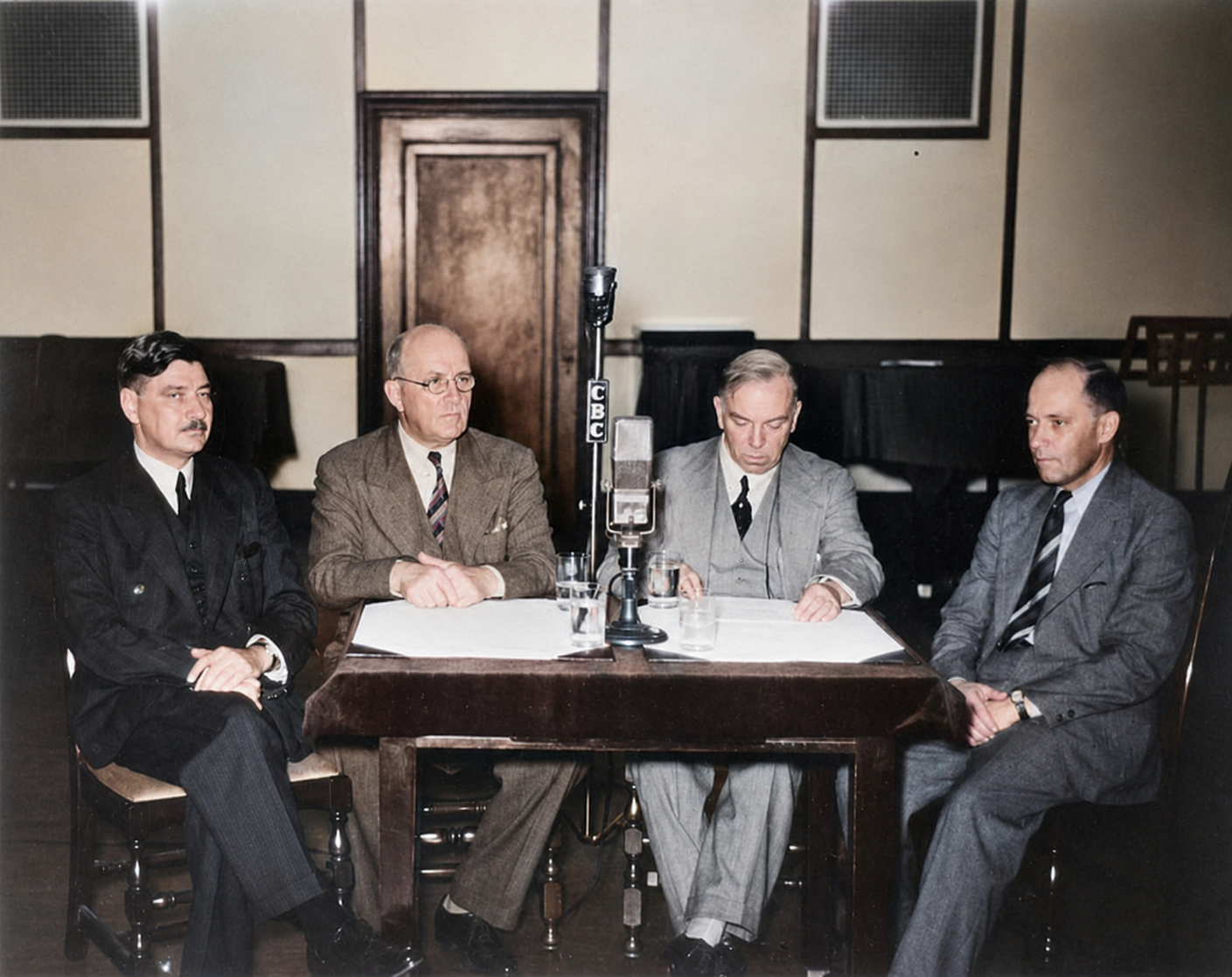
Mackenzie King and three Cabinet ministers sit around a table with papers and two radio microphones during an Ottawa broadcast.
Prime Minister Mackenzie King and Cabinet ministers sit before radio microphones, Ottawa. Colourised from original Library and Archives Canada photograph. National Film Board of Canada. Phototheque / Library and Archives Canada / C-016770

The Canadian House of Commons resumed at three o'clock this afternoon, and the question in front of it is still whether Canada goes to war.

Mackenzie King has told members that if the House adopts the Address in Reply, the Government will treat that as approval to ask for a formal proclamation of war against Germany.

So the mechanism matters more than it usually does. Members are not voting on a declaration. They are voting on an Address, and the Prime Minister has told them in advance what he will do with their vote. Anyone who votes for the Address knowing that is voting for the other thing, which is presumably the point of saying it out loud beforehand.

Correspondent

Moscow calls up reserve classes; TASS cites the war's menacing character

The Imperial Review
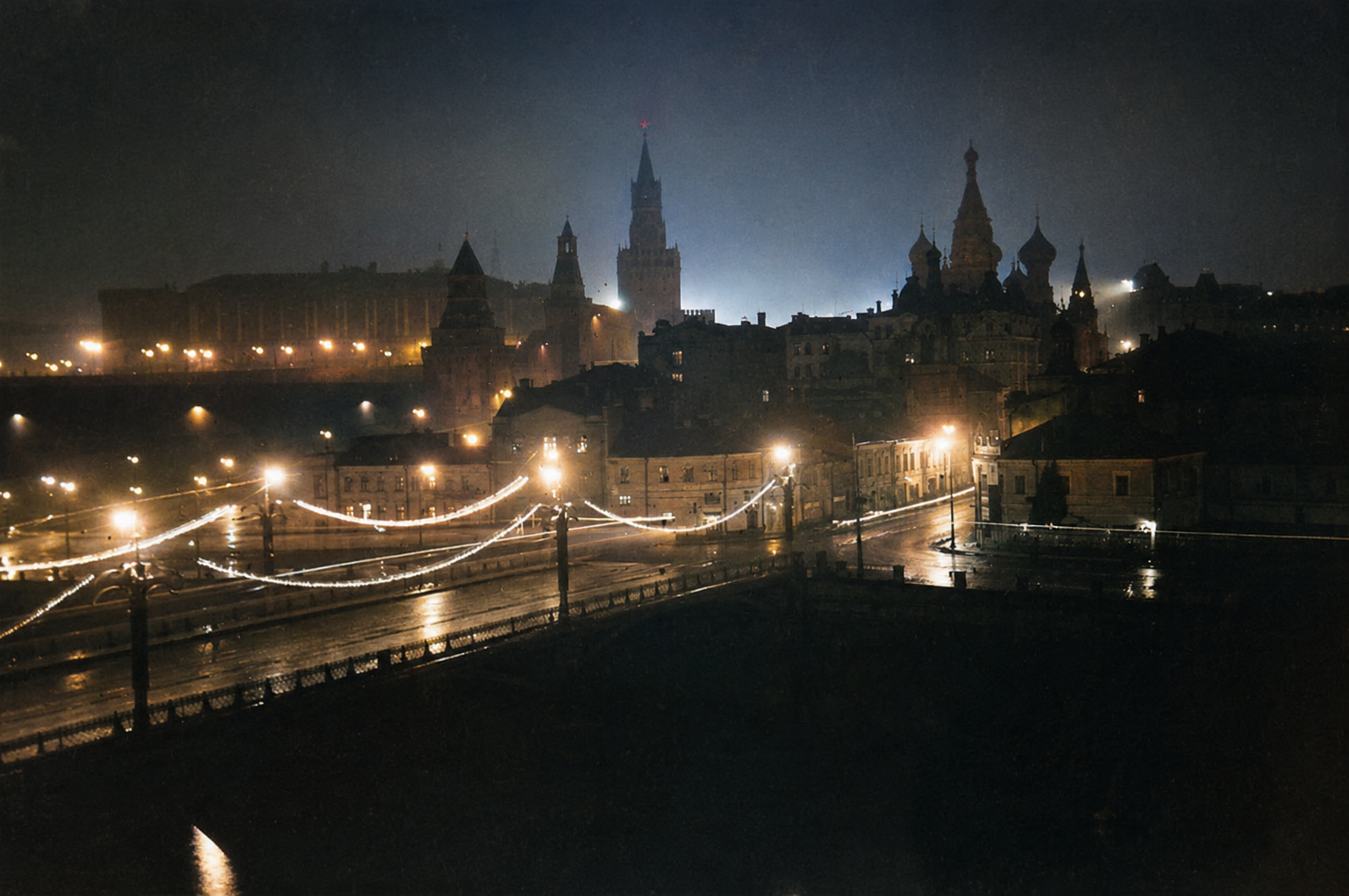
The floodlit walls and towers of the Kremlin and the clustered domes of St Basil's Cathedral rise above the Moskva river at night, their lights mirrored in the dark water below.
The Kremlin and St Basil's Cathedral above the riverfront, Moscow, photographed in 1935. Colourised from original Trondheim byarkiv photograph. Eirik Sundvor / Trondheim byarkiv, Tor.H46.B08.F22676 / CC BY 2.0

TASS, the official Soviet agency, announced today that members of several reserve classes are being called up. The reason given is that the German-Polish conflict is acquiring a “wide and menacing character”.

Earlier reporting has described the Soviet Union strengthening its western frontier and requiring cash payment in foreign trade.

The announcement should be read for what it is. TASS is the Soviet state speaking, and it has given a defensive explanation for a military measure. Defensive explanations are what states give for military measures. The explanation is the only one available and it is not evidence.

What can be said is that the largest country bordering eastern Poland is mobilising part of its reserves in the second week of an invasion of Poland, and has chosen to say so publicly rather than do it quietly.

Wire

Maritime Commission corrects City of Flint list to 113 non-Americans

The New York Register

The U.S. Maritime Commission has issued a corrected list of 113 non-American citizens, believed to be mostly Canadian, aboard the rescue ship City of Flint.

The commission said transmission problems had left the earlier list with the surnames correct and the Christian names wrong.

A separate list issued in Montreal names 171 people unaccounted for. It has been compiled from private cables, information from the Donaldson Line and incomplete survivor lists.

That figure is not a death toll and has not been presented as one.

The Athenia was sunk on the night of 3 September.

Correspondent

Berlin says Polish territory German before 1914 is to be German again

The Stockholm Observer

A German spokesman said today that Hitler intends to treat the territories of Poland that belonged to Germany before 1914 as German again.

This is a statement of intention by one government about another government's territory during an invasion of it. It is not a settlement, it has not been agreed by anyone, and no state has recognised it.

It is still worth reporting, because of what it tells you about the week. Until today Berlin's public language was operational: advances, positions, prisoners. Today it is about disposition. Governments talk about what they will keep when they have begun to think about keeping it.

Correspondent

RAF crossed into Belgium in error and fought Belgian fighters

The Imperial Review

British aircraft crossed into Belgian territory yesterday and fought Belgian fighters. The Air Ministry has said so itself, and Sir Robert Clive has been instructed to apologise in Brussels.

The aircraft were returning from a reconnaissance over central Germany. The Air Ministry's account is that the crossing was inadvertent. On the evidence available in London that account is neither confirmed nor contradicted, and it is Britain's own.

It is the fifth such flight since hostilities began. The same mission distributed further leaflets over Germany.

Two things are worth separating here. One is the navigation, which is an operational matter and will be dealt with as one. The other is that a belligerent's aircraft have exchanged fire with a neutral's over the neutral's own territory in the war's first week, and the belligerent has volunteered the fact rather than waiting to be asked.

Correspondent

Thirty of the 97 ships held at Gibraltar sail under destroyer escort

The Atlantic Ledger

Thirty British merchant ships left Gibraltar today under the protection of a destroyer squadron.

Ninety-seven had been sheltering there since Britain declared war on 3 September. Sixty-seven are still in harbour.

The machinery of convoy protection has been running since the declaration, mostly out at sea and behind an Admiralty that says almost nothing. Today it happened in front of a Spanish town with a view of the anchorage, and so it can be counted.

The count is the useful part. Why it is thirty and not ninety-seven is not something the Admiralty explains, and nobody watching from La Línea can tell you.

Graphic

Thirty of ninety-seven

97 British merchant ships sheltered at Gibraltar after the declaration. Thirty sailed today. Graphic by LIVE WW2, from Associated Press reporting. Graphic: LIVE WW2.
Wire

Missing Manaar lifeboat found; 23 men taken aboard

The Atlantic Ledger

One of the missing lifeboats from the British steamer Manaar has been found, and 23 men aboard it have been rescued.

The Italian steamer Castello Bianco picked them up, according to a Reuters report from Lisbon.

The Manaar was sunk earlier in the war's first week. One lifeboat, believed to be carrying 17 men, is still missing.

Wire

Tanker Kennebec reported torpedoed; whole crew rescued

The Atlantic Ledger

The British tanker Kennebec, 5,548 tons, has been torpedoed, according to a message from the Dutch liner Breedijk reported in Amsterdam today.

The whole crew has been taken off.

The Breedijk's message gives no position for the sinking and does not say what attacked the tanker. No time is given for the attack.

The Breedijk's message carries today's date; the attack itself may be older.

Wire

Helfrid Bismark placed south of the Sound; mine reported as cause

The Stockholm Observer

The loss of the steamer Helfrid Bismark is now being placed south of the Sound, a firmer position than the reports carried yesterday.

Reports reaching this office today agree on the area. A mine is reported as the cause.

Correspondent

Lwów radio calls villages to build barricades and take up arms

Allied Press Service

The Polish radio station at Lwów has told village populations to build barricades and defend themselves against the invading forces.

“All men, women and children must take up arms against the invaders,” the broadcast said.

The station is in the far east of Poland, more than 200 miles from the fighting reported around Warsaw. That is the part of this worth pausing on. An appeal of this kind, broadcast from Lwów, is addressed to places that were not expected to be in the war's path this week.

What it does not tell you is where the German army actually is. The broadcast is a Polish government station speaking to Polish civilians during an invasion, and it is asking them to do something. It is not a situation report and should not be read as one.

Wire

French High Command says Warndt Forest almost entirely in French hands

The Paris Dispatch

The French High Command has announced that the Warndt Forest, west of Forbach, has passed “almost entirely” into French hands.

The Warndt lies across the frontier on German territory. If the claim holds, it is the clearest publicly announced Allied advance onto German soil since the war began.

The announcement is the French command's own account of its operations. No independent confirmation of the extent of the advance has been given, and the report available here gives no line, no dates and no casualties.

Wire

Polish military mission reaches London by a route given only as secret

The London Sentinel

A Polish military mission has arrived in London, travelling by a route described publicly only as secret.

Neither the British nor the Polish authorities have said what the mission has come to discuss, or how long it will stay.

The mission is headed by General Mieczysław Norwid-Neugebauer. It was met on arrival by the Polish Ambassador, Edward Raczyński, the Polish military attaché, and a representative of the War Office.

Wire

Polish Government reported moving farther east from Lublin

Allied Press Service

Diplomatic dispatches reaching Budapest say the Polish Government is moving farther east.

The Government left Warsaw earlier in the campaign and established itself in the Lublin area. The reports say it is now moving again, away from the capital.

No destination is given. The reports do not say which ministries have moved or whether the Government is functioning during the move.

The Government's last known seat was the Lublin area.

Correspondent

Swedish Legation tells Stockholm Warsaw is not occupied

The Stockholm Observer

A report reaching Stockholm this morning says the Swedish Legation in Warsaw has advised that the capital is not occupied and remains under Polish control.

It is an account of the city from a source that is not fighting over it, which is what has been missing.

Since yesterday afternoon the only two sources on Warsaw have been the two armies. Berlin says its armoured troops entered the capital yesterday afternoon. Warsaw says that is completely false. Neither side can be checked against the other, and neither has produced anything a neutral desk can weigh.

The Legation's position is different in kind. Its staff are inside the city. Foreign missions in Warsaw are still functioning, which is itself a fact about the city's condition.

Wire

Berlin and Warsaw broadcasts still contradict each other on the capital

The Stockholm Observer

German and Polish broadcasters are still making conflicting claims to the possession of Warsaw this morning.

Berlin continues to say German troops have entered the Polish capital. Polish broadcasts continue to deny it. The German claim was first made yesterday afternoon and denied by the Polish Embassy in London the same evening.

Both sources are belligerent. No account from any third party has established where German troops stand in relation to the city.

Warsaw's radio stations are still transmitting.

Wire

Air-raid alarms sound twice over Berlin; no aircraft seen

Allied Press Service

Air-raid alarms sounded twice over Berlin overnight, the first the German capital has heard since Britain and France entered the war.

The first alarm sounded at 03:58 Berlin time and a second at 04:20. Civilians went into shelters on both occasions.

The Associated Press reports no sign that enemy aircraft reached the city. Searchlights were not switched on.

The second alarm came twenty-two minutes after the first.

Wire

Canadian Commons rises at eleven; sits again Saturday afternoon

Allied Press Service

The Canadian House of Commons has adjourned at eleven o'clock Ottawa time after an evening sitting on the Address in Reply, the debate that will determine whether Canada enters the war.

No vote has yet been taken.

Prime Minister Mackenzie King has told members that adoption of the Address will be treated as approval for the Government to request a formal proclamation of war against Germany.

The House resumes at three o'clock on Saturday afternoon.

Correspondent

Woodsworth tells the Commons he cannot consent to another war

The Southern Cross

The Canadian House of Commons came back at eight o'clock tonight to go on arguing about whether Canada is at war, and J. S. Woodsworth has told it that he will not agree to it.

Woodsworth said he could not give his consent to anything that would drag the country into another war. He put it as his own position rather than anyone else's. The House heard him out.

That is worth understanding from a distance. Britain declared war on Germany on 3 September. Canada did not, and the Dominions were not expected to. What is going on in Ottawa tonight is a Parliament deciding, in its own right, whether the country follows.

The day in pictures

97 British merchant ships sheltered at Gibraltar after the declaration. Thirty sailed today. Graphic by LIVE WW2, from Associated Press reporting.Graphic: LIVE WW2.
The floodlit walls and towers of the Kremlin and the clustered domes of St Basil's Cathedral rise above the Moskva river at night, their lights mirrored in the dark water below.
The Kremlin and St Basil's Cathedral above the riverfront, Moscow, photographed in 1935. Colourised from original Trondheim byarkiv photograph.Eirik Sundvor / Trondheim byarkiv, Tor.H46.B08.F22676 / CC BY 2.0
Mackenzie King and three Cabinet ministers sit around a table with papers and two radio microphones during an Ottawa broadcast.
Prime Minister Mackenzie King and Cabinet ministers sit before radio microphones, Ottawa. Colourised from original Library and Archives Canada photograph.National Film Board of Canada. Phototheque / Library and Archives Canada / C-016770

Where things stood at the start of the day

Poland
Berlin says its armoured troops entered Warsaw at 5.15 yesterday afternoon, Berlin time, and the Polish Embassy in London calls the report false. No third account exists, the German statement names no unit, and Berlin gives 25,000 Polish prisoners taken against Warsaw's 1,500.
The Atlantic
Two ships have been lost in neutral waters, both attributed by survivors to mines: a Dutch minesweeper off the Dutch coast with 29 reported dead, and the German steamer Helfrid Bismark south of the Øresund with seven dead. Neither figure is final.
Britain at home
Still not given: any figure for the aircraft lost over Wilhelmshaven on Monday, any new total for merchant ships sunk since the Athenia, or any detail of where the convoys are sailing. Berlin's five bombers remains the only loss figure in circulation.
Western Front
Communiqué No. 9 reports new local advances in the Saar sector and strengthened forward positions, giving no distances, place names or casualties. Paris papers put the northern flank seven or eight miles into Germany, a figure the High Command has not confirmed.
The Empire
Canada's Commons debate continues without a vote. Mackenzie King said Canada will act with Britain and France if the House supports the government, and that a government unable to carry the House should give way; Canada has not declared war.
Neutrals
Roosevelt has proclaimed a limited national emergency, confined to enforcing neutrality and strengthening defence within peace-time powers. Two further proclamations extend the neutrality law and the arms embargo to South Africa, and Canada remains off the list.
Background

Why Ottawa must vote before it can declare

Britain declared war on Germany on 3 September. Canada did not, and nobody expected it to.

Each Dominion decides. Under the Statute of Westminster the Dominions are not bound by a British declaration. Each decides for itself, and the decision belongs to its own parliament. That is why the Canadian House of Commons has been sitting through the night on a question that in London took a morning.

The instrument before the House. The instrument in front of members is not a war vote. It is the Address in Reply to the Speech from the Throne, the ordinary parliamentary response to a government's programme. What makes it consequential is that Mackenzie King has told the House what he will do with it: if the Address is adopted, the Government will treat that as approval to request a formal proclamation of war against Germany.