Skip to the day
LiveWW2The Second World War, in real time
Day 13
Wednesday 13 September 1939

Chamberlain tells the Commons the troops are in France and will say nothing more about them, the House then spends the afternoon on the night police went through Fleet Street to take the same news back, and a French warship is destroyed at Casablanca with no figure given for the missing

From the LIVE WW2 feed

The day in dispatches

Filed through the day, as it happened
Newest first
Editorial

The armies are fighting for ground and the governments are fighting over the news

The London Sentinel

The Prime Minister spoke to the Commons for half an hour this afternoon and told it very little. British troops are in France. He did not say how many, or where, or when they will fight. The French advance has been completely successful. He did not say at what, or against whom, or how far.

That much is defensible. There are things an army cannot say aloud with an enemy listening, the House knew which things they were, and it did not press him on them.

What it pressed him on was Monday night. The Ministry of Information authorised a fact. The General Staff decided the fact should not have been authorised. Police went through Fleet Street at 00.45 taking back newspapers that were already on trains. Paris radio had broadcast the same fact twice that day, and the House was told it had been in the American papers for the better part of a week.
Summary

Where things stand tonight

Allied Press Service

Poland. Polish communiques say German attempts on the Narew and the Bug were beaten off and that Modlin is holding. Berlin says the ring around Warsaw was closed in the east yesterday. No account from outside the two commands has reached here.

Britain. Chamberlain told the Commons that British troops are in France and have not been in action, and that the French advance in the West is local and so far completely successful. He gave no particulars of either. Three Polish destroyers have joined the Fleet, and RAF squadrons are flying from French soil.

Information. The Commons spent the afternoon on Monday night, when the arrival of British troops in France was authorised, withdrawn, seized by police and released again inside six hours. Sir Samuel Hoare apologised and announced a change in how the Service departments and the Ministry of Information will work together.

Casablanca. A French warship was destroyed by two explosions in the harbour at 09:40 GMT. The Navy has announced the accidental loss of the cruiser La Tour d'Auvergne and has given no casualty figure.

Washington. Congress is summoned for the 21st.

Paris. Daladier takes Foreign Affairs and creates a Ministry of Blockade.

Ottawa. The supply bill received Royal Assent at 17:15 GMT.

Wardha. The Congress Working Committee is still sitting.

Wire

Ottawa's supply bill has Royal Assent, but nobody has been appointed to run it

Allied Press Service
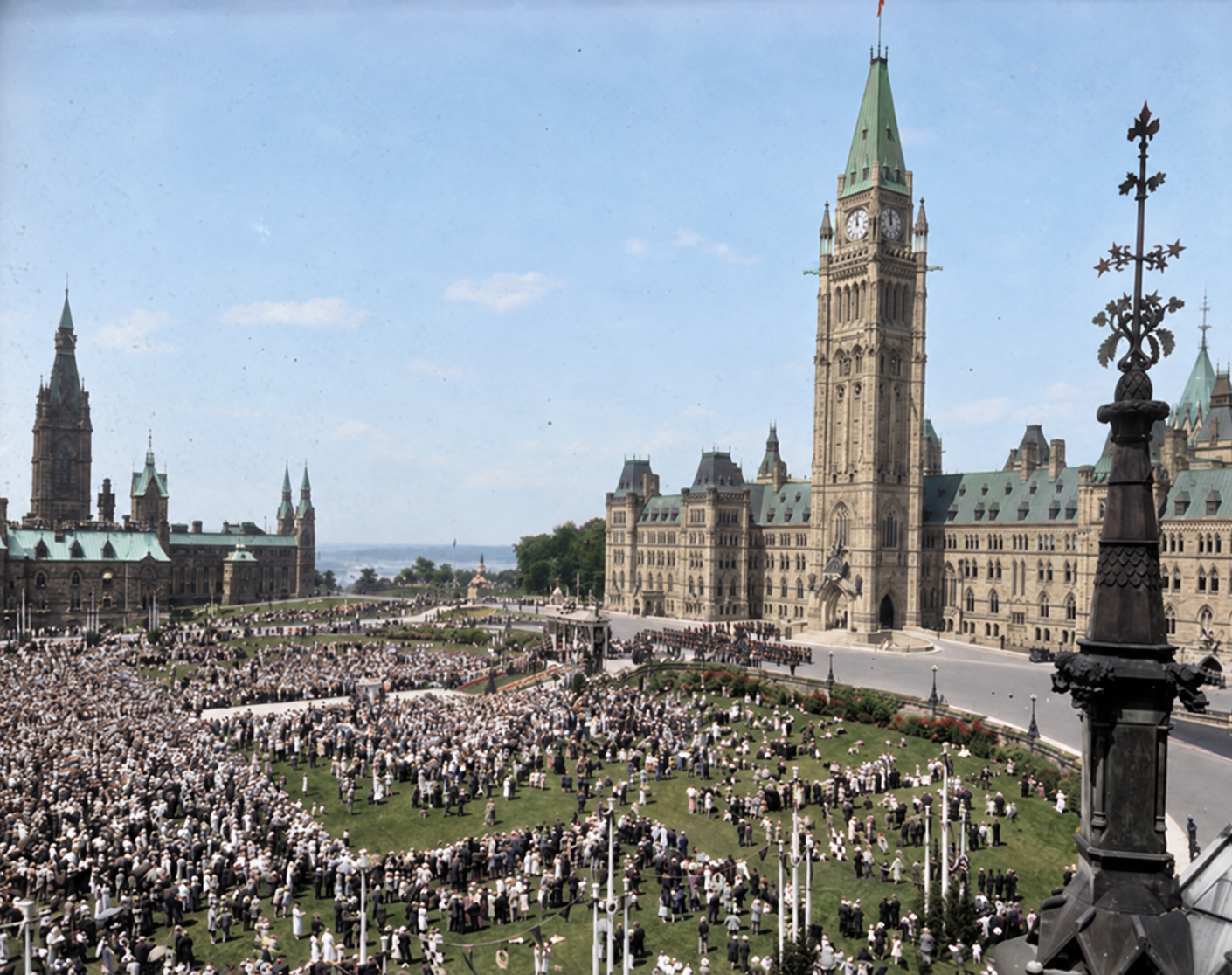
A large crowd fills the lawns of Parliament Hill in Ottawa below the Centre Block and Peace Tower during the 1927 Diamond Jubilee celebrations.
Parliament Hill during the Diamond Jubilee celebrations, Ottawa, 1927. Colourised from original Library and Archives Canada photograph. Library and Archives Canada, PA-027624.

The Canadian measure creating a Department of Munitions and Supply completed its passage through Parliament and received Royal Assent at 17:15 GMT today.

The Act establishes in law the office of Minister of Munitions and Supply, with authority over the purchase and production of war material.

It does not yet operate. The Act requires proclamation before it comes into force, no proclamation has been issued, and no minister has been appointed to the portfolio.

What exists in Ottawa tonight is the legal machinery, complete and waiting.

Correspondent

Daladier takes Foreign Affairs himself and creates a Ministry of Blockade

The Paris Dispatch

Edouard Daladier has reorganised his government and kept the largest part of it himself. He remains President of the Council and Minister of National Defence and War, and he now takes Foreign Affairs.

Georges Bonnet, who has held the Quai d'Orsay for the past year, goes to Justice. No reason was given for the move.

Two of the portfolios did not exist a month ago. Raoul Dautry, who ran the state railways, takes Armaments. Georges Pernot takes Blockade, a ministry whose work is economic warfare: what reaches Germany by sea, what reaches it through neutral countries, and what France can arrange with those countries to stop it.

Communiqué

The President summons Congress for the 21st, and does not say why

Allied Press Service

President Roosevelt has called Congress into extraordinary session, to meet at noon Washington time on Thursday 21 September, which is 16:00 GMT. The proclamation was signed shortly before noon in Washington today and gives no reason beyond the constitutional formula. Washington reads the summons as concerning the neutrality legislation and the arms embargo, which Roosevelt himself brought into effect by proclamation on 5 September. The document says nothing on that subject. The operative text follows.

Official textThe President of the United States

Whereas public interests require that the Congress of the United States should be convened in extra session at twelve o'clock, noon, on Thursday, the Twenty-first day of September, 1939, to receive such communication as may be made by the Executive;

Now, Therefore, I, Franklin D. Roosevelt, President of the United States of America, do hereby proclaim and declare that an extraordinary occasion requires the Congress of the United States to convene in extra session at the Capitol in the City of Washington on Thursday, the Twenty-first day of September, 1939, at twelve o'clock, noon, of which all persons who shall at that time be entitled to act as members thereof are hereby required to take notice.

FRANKLIN D. ROOSEVELT

Correspondent

Between 19.52 and 01.55, the news was released, withdrawn, seized and released again

The London Sentinel
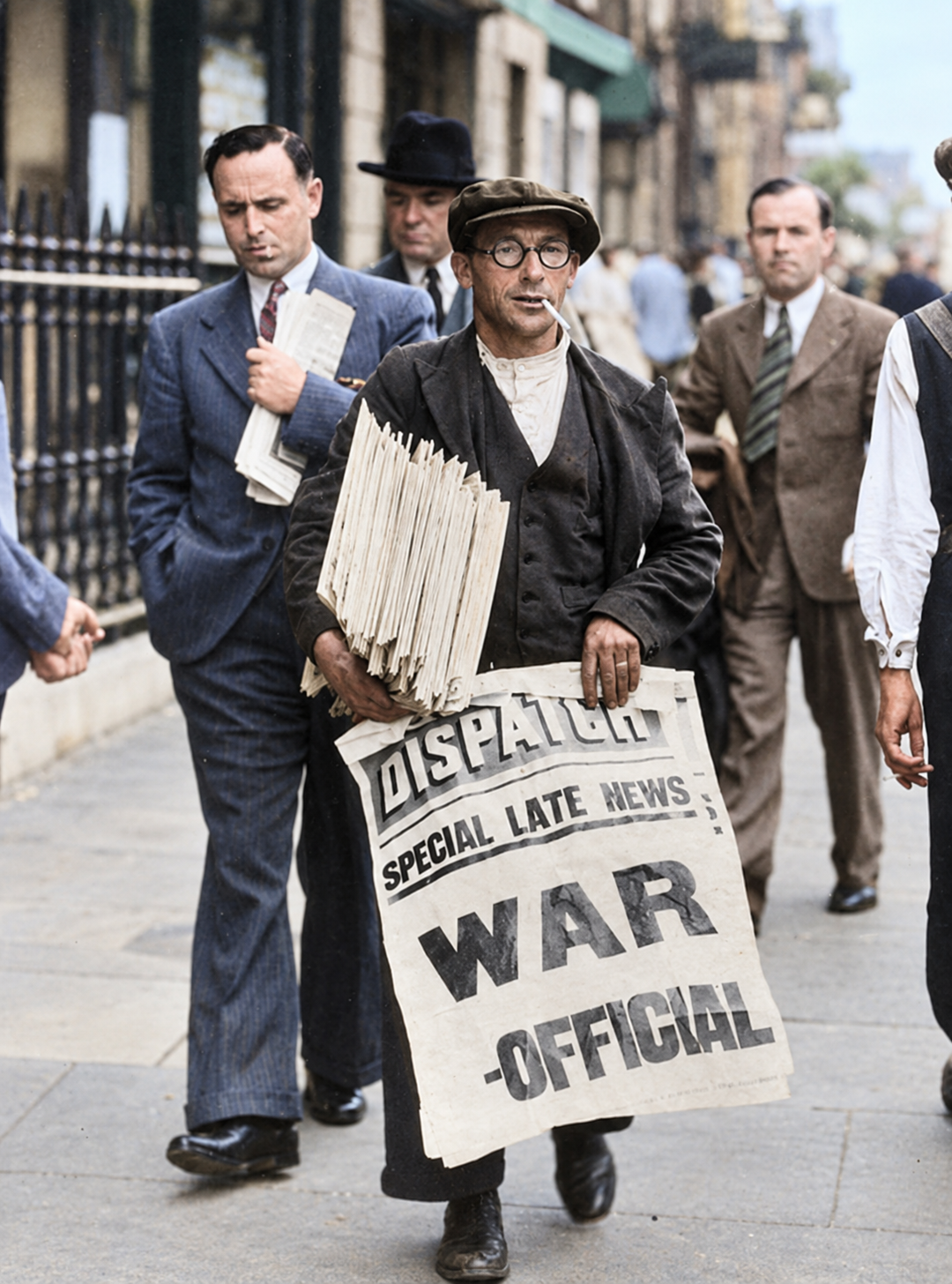
A newspaper vendor in a flat cap carries a bundle of papers under one arm and a large printed placard reading Special Late News, War Official, as pedestrians walk past him along a London pavement.
A newspaper vendor carries late war news in Whitehall, London, 7 September 1939. Colourised from original Library of Congress photograph. Library of Congress, LC-USZ62-132594.

Six hours of Monday night were read into the Commons record this afternoon. Most of it came from an account the Daily Express supplied and Arthur Greenwood read aloud. Hansard establishes that he read it. It does not establish that every line of it is true.

On the Express's account, the Ministry of Information authorised the paper at 19.52 GMT to publish that British troops had arrived in France. The Lord Privy Seal told the House this afternoon that the War Office gave the authorisation at 20.00. The two times do not agree, and nobody in the Chamber reconciled them.

Wire

Hoare tells the Commons the General Staff overruled the release

Allied Press Service

The Lord Privy Seal gave the Government's account of Monday night in a reply to the Commons that began at 16:33 GMT.

Sir Samuel Hoare said the War Office authorised the release of messages from France about the presence of British troops at 20:00 GMT on Monday; that the Ministry of Information then drew the War Office's attention to the danger of further detail being published under the voluntary censorship; and that the General Staff took the view that the risk was great and that there should be no publication at all.

Permission was withdrawn in the middle of the night. Editions were already out by then, and the prohibition was cancelled.

Hoare apologised for the confusion. He said a senior officer of each Service department will now sit full-time inside the Ministry of Information.

Correspondent

Casablanca has a wreck at the jetty and no figure for the missing

The Paris Dispatch

The fire at the jetee Delure was still burning through the afternoon, and the Marine Nationale's only statement so far is a brief communique announcing the accidental loss of the cruiser La Tour d'Auvergne.

The sequence, so far as it can be established here, is short. At 09:40 GMT, twenty to eleven by the clocks in the port, an explosion opened the vessel between the mast and the after funnel. A second came within seconds and was heavier than the first. The after part of the ship went down where she lay. Debris was thrown across the jetty and into the port, and windows went in across a wide part of the town.

Wire

Chamberlain says three Polish destroyers are now with the British Fleet

Allied Press Service

Three destroyers of the Polish Navy have joined the Fleet and are taking part in the work of the light forces, the Prime Minister told the Commons this afternoon. He described them as very efficient.

A number of Royal Air Force squadrons are now operating from French soil, he said, naming neither the squadrons nor where they are based.

On the sea war, Chamberlain put German shipping at sea or in neutral and allied ports at the outbreak, Baltic ports excepted, at in the neighbourhood of 1,105,000 tons. Practically all of it has now been cleared from the high seas, he said, some captured and much of it interned in neutral ports. British merchant losses, on his account, have been somewhat severe.

Wire

Chamberlain says British troops are in France and have not been in action

Allied Press Service

In a statement to the Commons that began at 14:51 GMT, the Prime Minister said reports of the British Expeditionary Force having already been engaged are not accurate. British troops are in France, he said, and have not been in action. When that changes, as much information as the military situation permits will be issued at once.

He attributed the reports to foreign correspondents, over whose activities he said the Government has no control.

On the Western Front, Chamberlain said the French armies have begun a methodical advance. The operations so far have been local, intended to straighten the line and gain contact with the main German positions. He called it an essential preliminary phase and said it had been completely successful, and left it there.

Wire

Two explosions tear through a warship in Casablanca harbour

Allied Press Service

A French naval vessel lying alongside the jetee Delure at Casablanca was torn open by two explosions this morning, the second following the first within seconds and heavier than it.

The time was 09:40 GMT, twenty to eleven by Casablanca clocks. The detonation was heard at a great distance from the port. Debris was thrown across the jetty.

No casualty figure has been given and the French naval authorities have issued no statement on the cause. The fire is still burning.

Correspondent

Congress is still sitting at Wardha, and it has published nothing

The Imperial Review

The Working Committee of the Indian National Congress has been in session at Wardha since Sunday and has published nothing.

It is considering a question India was never asked. The Viceroy declared India at war on 3 September under machinery that required the agreement of no elected Indian body, and the Committee has been meeting ever since to settle what Congress thinks about a decision already taken.

Nothing has come out of the room. What is known is that Congress holds men who will not support a war fought by an empire that governs them, and men who will not stand aside from a war against Germany, and that both are in the building.

Wire

Berlin says the ring around Warsaw was closed in the east yesterday

Allied Press Service
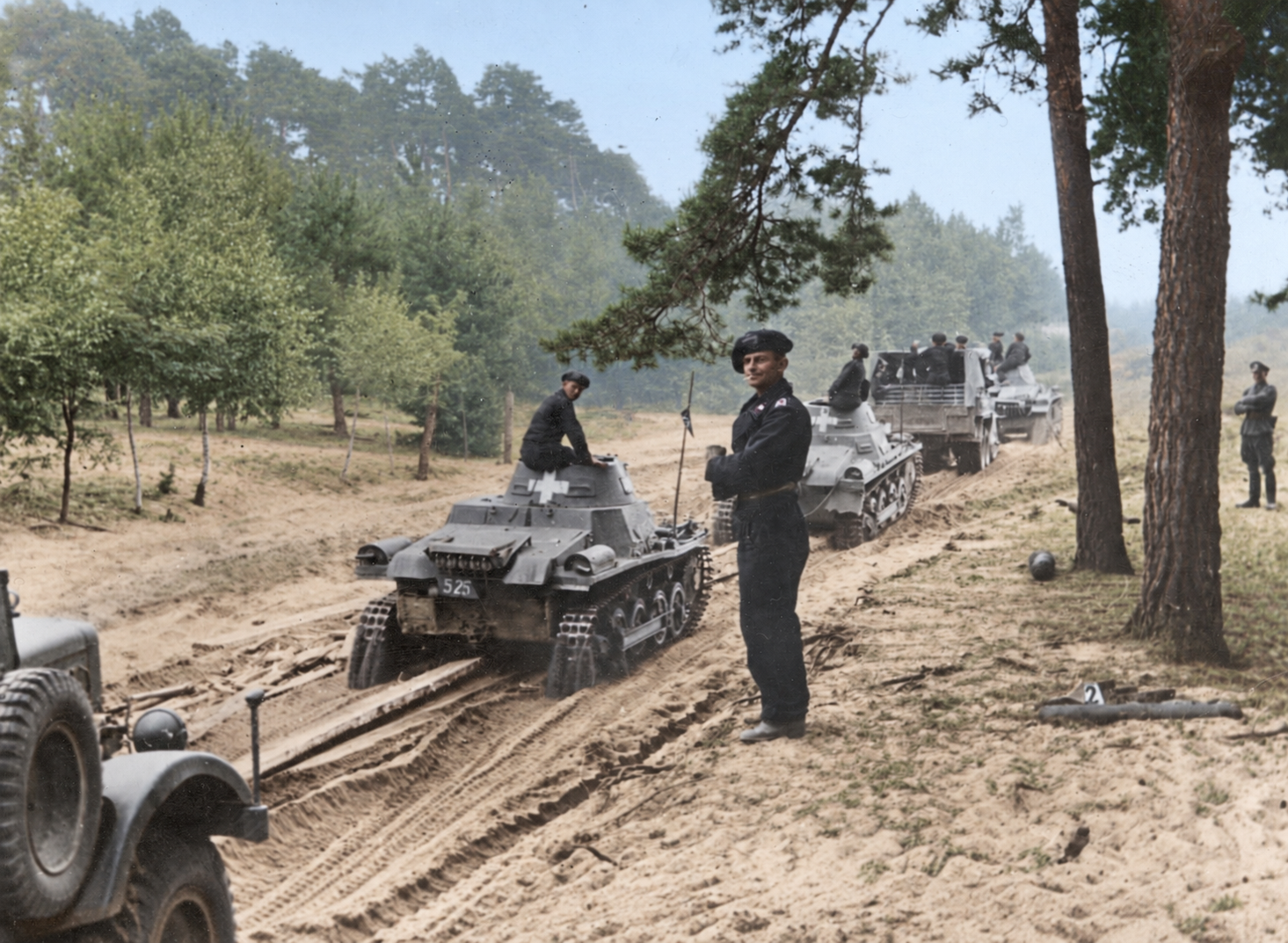
Two German light tanks stand on timber boards laid across a sandy track at the edge of pine woods, with crewmen in black uniforms beside them and a lorry and further vehicles behind.
German tanks halted on a sand track near Płudkowice, 11 September 1939. Colourised from original National Digital Archives photograph. Narodowe Archiwum Cyfrowe, 3/2/0/-/42/1. Public domain.

German reporting through the night presents the Polish position as collapsing and says the ring around Warsaw was closed in the east yesterday.

The material comes from DNB, the German state agency, and from German command communiques.

It does not directly contradict the Polish communiques, which concern particular attacks on the Narew and the Bug. The two accounts describe different sectors at different scales, and no report from outside either command has arrived to set them against each other.

Wire

Poland's claims from yesterday still stand, and nothing has come in to test them

Allied Press Service
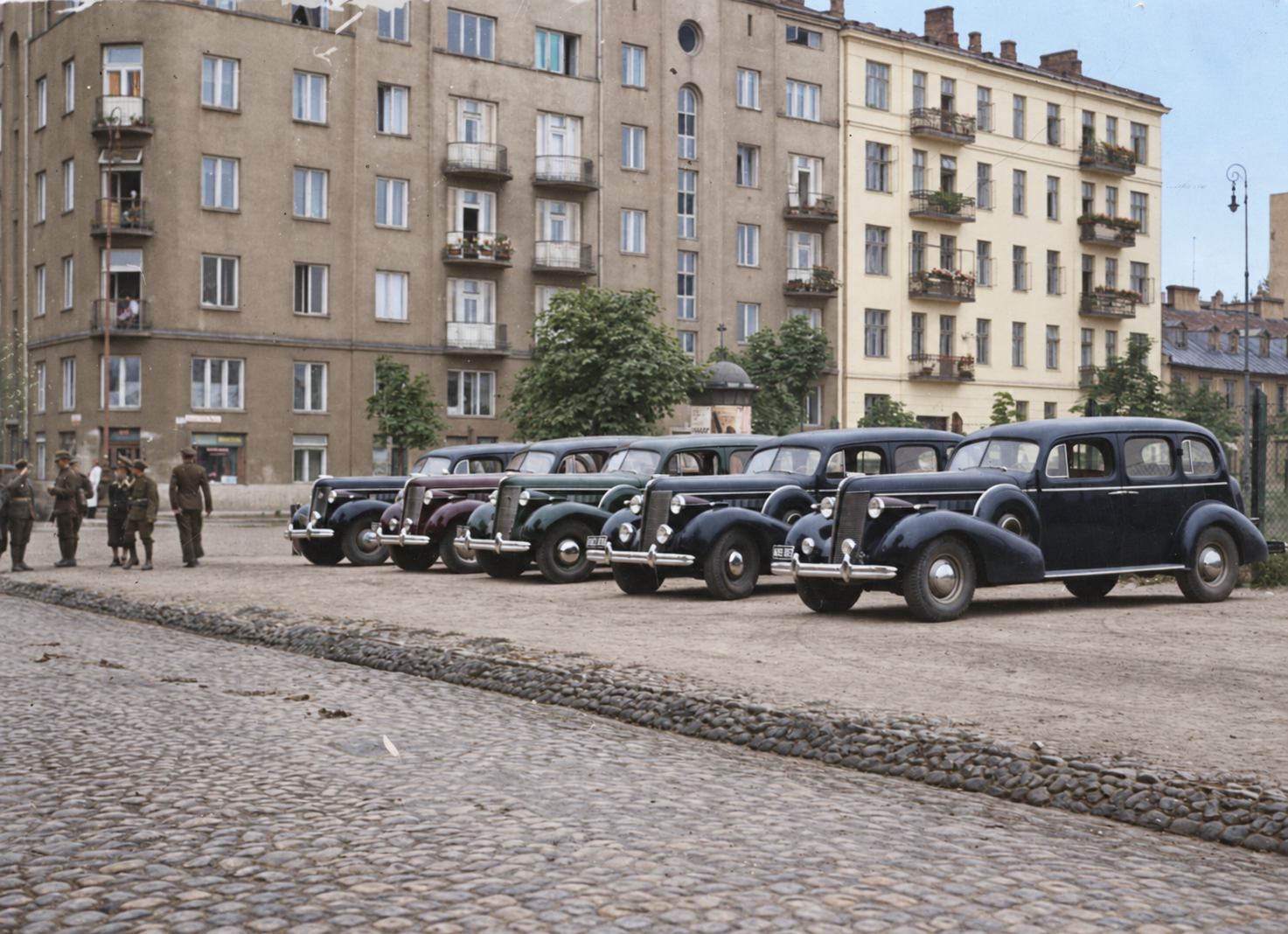
Five civilian cars line up for military registration in Warsaw while several men stand beside them in front of an apartment block.
Civilian cars await military registration, Warsaw, August 1939. Colourised from original National Digital Archives photograph. Narodowe Archiwum Cyfrowe, 3/1/0/7/3125/1. Public domain.

The Polish communiques circulating since yesterday say German attempts to force the Narew and the Bug have been frustrated, that heavy fighting is continuing between Kutno and Warsaw, and that the fortress at Modlin is holding out.

They reach London through Press Association relays. Nothing has arrived overnight to supersede them, and nobody outside the Polish command has tested them.

Modlin stands where the Narew meets the Vistula and covers the northern approach to the capital. The fighting there is continuing.

The day in pictures

Five civilian cars line up for military registration in Warsaw while several men stand beside them in front of an apartment block.
Civilian cars await military registration, Warsaw, August 1939. Colourised from original National Digital Archives photograph.Narodowe Archiwum Cyfrowe, 3/1/0/7/3125/1. Public domain.
Two German light tanks stand on timber boards laid across a sandy track at the edge of pine woods, with crewmen in black uniforms beside them and a lorry and further vehicles behind.
German tanks halted on a sand track near Płudkowice, 11 September 1939. Colourised from original National Digital Archives photograph.Narodowe Archiwum Cyfrowe, 3/2/0/-/42/1. Public domain.
A newspaper vendor in a flat cap carries a bundle of papers under one arm and a large printed placard reading Special Late News, War Official, as pedestrians walk past him along a London pavement.
A newspaper vendor carries late war news in Whitehall, London, 7 September 1939. Colourised from original Library of Congress photograph.Library of Congress, LC-USZ62-132594.
A large crowd fills the lawns of Parliament Hill in Ottawa below the Centre Block and Peace Tower during the 1927 Diamond Jubilee celebrations.
Parliament Hill during the Diamond Jubilee celebrations, Ottawa, 1927. Colourised from original Library and Archives Canada photograph.Library and Archives Canada, PA-027624.

Where things stood at the start of the day

Warsaw
Polish General Headquarters said German forces had been driven back and put the nearest about six miles from the centre. Berlin said its encirclement was tightening; both statements were issued on the 12th and neither can be checked.
Lwów
The city's radio said volunteers were digging trenches and building shelters. German reporting claimed an advance towards the region, and that claim was the only basis for any statement about how near the fighting had come.
Western Front
The French morning communiqué reported a calm night east of the Saar. Depth, units and losses stayed out of it, as they have since the operation began.
Britain
The government announced that British troops are in France and have not been in action, giving no units, numbers or ports. Between 7,000 and 8,000 civil servants are leaving London for undisclosed destinations.
The Atlantic
Both crews torpedoed on Monday were reported safe, the Firby's aboard Scanpenn and the Inverliffey's aboard the American R. G. Stewart. No survivor figure was given for either ship.
France
Chamberlain met Daladier somewhere in France for talks on the conduct of the war. The censor released the meeting and kept its location and contents.
Canada
Ottawa's first war budget put a 20 per cent surtax on income tax, taxed excess profits and raised duties on tobacco, tea and coffee. The munitions and supply bill was still before the Commons at the close of the day.
The neutrals and the Dominions
Latvia ordered three military classes to report and gave no reason. Australia appointed a Controller of Shipping; England and Wales will plough 1.5 million more acres for next year's harvest.